![Heights Platform Best Online Course and Community Platforms in 2026 [All-in-One Platforms for Creators]](https://uploads.heightsplatform.com/program/public/blogarticle/1023/cover_image/3c016ac3d104e999a41a2ee76522acbb.jpg)
Best Online Course and Community Platforms in 2026 [All-in-One Platforms for Creators]
32 minute readIf you are thinking about starting your own creator business, it can feel overwhelming with the number of tools and platforms available out there.
Today, there is an app for everything: whether you want to create a course, build a thriving community, sell access to digital products or go live in front of your audience.
We understand that the process of choosing the right platform for your business can be a tedious one, and either you are eager to get it over with or you want to dig into all the details to pick the right platform.
But nevertheless, it is an important step - one that can change the direction and overall success of your business.
And if you are new at this, it can be hard to even understand which tools and features you will need in the future, to make sure that the platform you are investing in is one that you can scale with. The good news is that we are experts in this matter.
We have been in the creator industry for years, and we've seen and helped 10,000+ creators build and grow their online knowledge business. They've told us which features they care about the most, and why they choose one platform over another.
So today, we are gonna compare the most popular tools out there for creators, focusing on the platform that allows you to build and grow a creator business without having to piece together multiple software, or hire a developer.
The tools and platforms we are going to compare are the best choice for creators and entrepreneurs who want to create some kind of info-product or membership related business and want to:
- Start selling online courses and digital products
- Create a private or public community space under their own brand
- Build their entire website
- Use AI to simplify their workflow
- Engage their audience and customers with live streaming
- Create a business that can scale
Let's get right into it. Here are the best all-in-one platforms for creators to sell online courses and digital products, build a community and grow a profitable online business:
Table of Contents
#1: Heights Platform
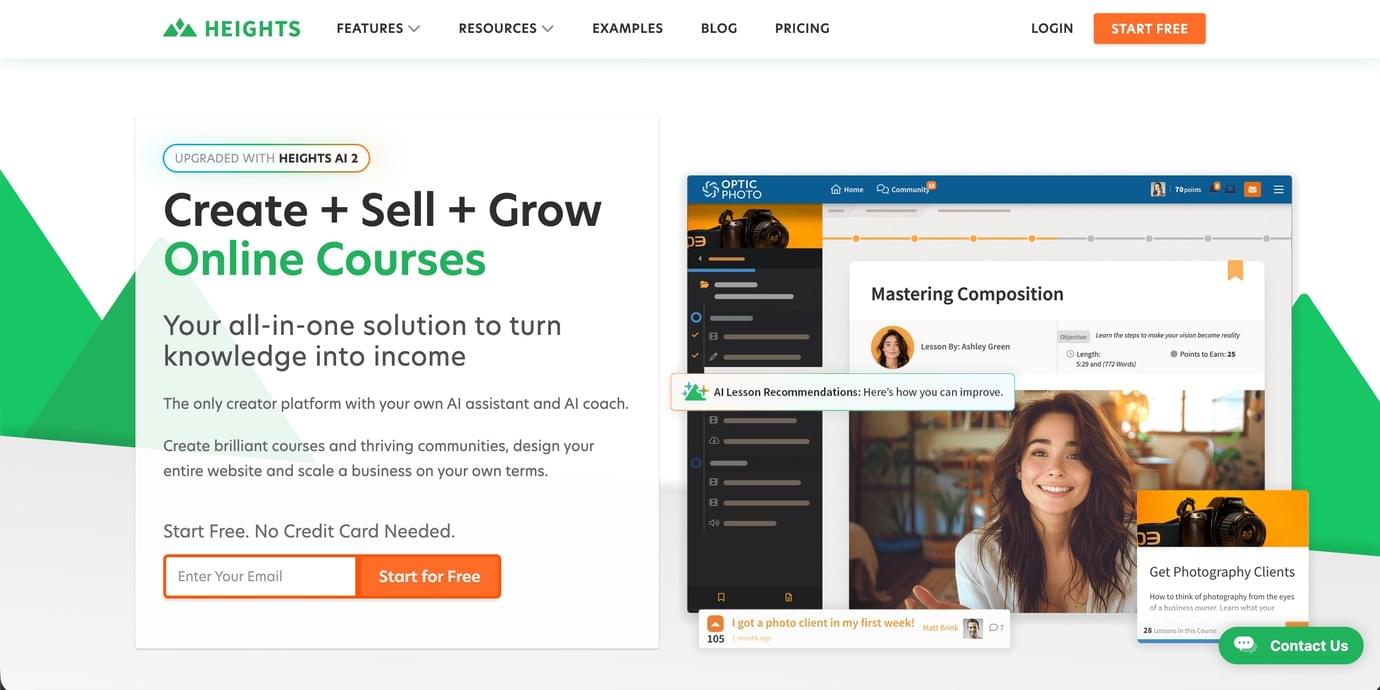 Heights Platform is the all-in-one, AI-powered online course creation and community-building platform.
What creators love most about Heights is its flexibility and transparency. There are so many different ways that a creator can structure their business on Heights, and it fits any digital product business model. Plus, Heights Platform doesn't take any commissions from creators' earnings; its pricing is transparent and free of hidden fees.
Thanks to its ease of use and wide range of features, it is the perfect choice for both creators who are just starting out and experienced creators who need room to grow and scale.
Heights Platform focuses heavily on updating the software based on what creators need most and on current trends in online learning. One of the latest additions to the platform is Live Streaming and Meeting Rooms - officially replacing Zoom or any costly webinar software.
In fact, a big focus on Heights Platform is on student engagement and community building - and helping creators grow their business organically, without heavily relying on social media.
Start Free TodayLet's see an overview of the main features you'll get inside Heights Platform:
- Create unlimited online courses and digital products: on the Basic plan and up, there are no limits on how many digital products you can create (online courses, digital downloads, community channels, offers, time-sensitive courses).
- Courses designed to drive engagement: your students will love learning with your thanks to Heights Platform built-in engagement tools such as badges, points, assignments, quizzes, certificates, community, projects and more.
- Heights AI: the AI tools in Heights Platform are more than a simple "writing tool". Heights AI actually saves you time by becoming your own personal assistant, available 24/7. It can answer questions about Heights and growing your business, edit product settings on your behalf, create entire offers based on simple prompts and even coach you weekly on how to reach your sales goals!
- Private / Public Community: You can add community spaces alongside your courses to increase engagement - and choose whether to keep your community private or public (or a mix of both). Public community posts are indexable by Google, helping you rank higher on search engines and gain new customers simply by posting in your community!
- AI Website Builder: create entire websites in seconds with AI. Simply describe your page goals and design style to Heights AI, and it generates a unique, personalized website page automatically linked to your courses in seconds. Or if you prefer to build your website without AI, use Heights Platform's drag-and-drop website builder and choose from many beautiful templates.
- Live Streaming and Meeting Rooms: go live in front of your audience and students directly inside your branded program. Host group video calls within your community (replaces Zoom), or set up live streams to sell as digital products (replaces Webinar software).
- Sell B2C or B2B: Heights Platform adapts to your business model. If you sell B2B, access powerful features to deliver course access to 100+ employees using a single link, and create multiple separate offers or memberships for each of your clients, all under the same roof. No more complex workflows and unprofessional workarounds.
- Marketing Tools: Send emails to your students and schedule newsletters based on your customers' actions, create your own affiliate program, publish unlimited blog posts and AI website pages, grow a thriving community and integrate seamlessly with your favorite tools.
We could talk about Heights Platform and its features for hours, but for the sake of this article, let's see the main Pros and Cons of this course creation software, and who it is for:
Price of Heights Platform:
From $19/month
Who is it for?
Course creators, coaches, creative entrepreneurs, community builders, complete beginners and experienced experts, as well as B2B creators and companies that want a scalable knowledge business under one brand.
Best of Heights Platform Features:
- Unlimited products including courses, memberships, downloads, and bundles
- No transaction fees on your sales
- Strong AI tools built directly into the platform
- True all-in-one system (courses, website, marketing tools, live streaming, and community)
- Public community posts that can be indexed by Google
- Designed for both individual creators and B2B companies
Cons:
Some users may experience a learning curve due to the breadth of features, though built-in AI guidance helps you get started and navigate the platform efficiently
#2: Kajabi
 Kajabi is an all-in-one platform built to help experts create, market, sell, and deliver digital products from one dashboard. You can build courses, coaching programs, memberships, and communities, then connect them to landing pages, email campaigns, automations, and funnels so your marketing and delivery stay connected.
Kajabi’s main trade-off is cost and scaling limits on the lower plan. The entry plan starts at $179/month (or $143/month billed annually), and it caps you at 5 products and 1 community, so creators with multiple courses, downloads, and community spaces may upgrade sooner than expected. If you want a fully white-labeled mobile app, Kajabi offers a Branded App as an add-on starting at $199/month on top of your base plan.
Kajabi also includes a built-in community experience, with features like Live Rooms and Events, plus challenges and gamification to drive participation. If your growth strategy depends on email marketing, structured funnels, and a polished checkout flow, Kajabi’s all-in-one setup can reduce the number of tools you need to stitch together.
Price of Kajabi:
From $143/month
Payment processing fees apply, and Kajabi lists separate rates depending on the payment method you use.
Who is it for?
Coaches, educators, practitioners, creators, and service professionals who want one system to manage products, marketing, and delivery together, with a strong emphasis on funnels and email automation.
Best of Kajabi Features:
- Built-in funnels and email marketing automation designed to work together
- Flexible online course and coaching business models
- Integrated community feature for member interaction
Cons:
- Higher starting price compared to many creator platforms
- Product limits on Basic and Growth plans (5 products and 1 community on the Basic plan)
- Branded mobile app available as an add-on starting at $199/month above your base plan
How does Kajabi compare to Heights Platform?
Kajabi is a strong option if your priority is running funnels and email automation alongside your courses in one system. It is built around marketing structure and campaign flows.
Heights Platform is designed for creators who want to scale without structural limits. Unlimited courses, products, and communities are included from the start, so growth does not require plan upgrades based on product count.
Heights puts engagement and organic visibility at the center. Public community posts can attract search traffic over time. Live workshops, group calls, and streaming happen directly inside your program under your own branding. Heights also includes an integrated AI assistant that helps you build offers, organize content, and move faster, giving creators a more flexible foundation for long-term growth.
#3: Circle
 Circle is a community-first platform built to help creators run paid memberships and learning programs in one branded space. You organize your program into “spaces” for discussions, chat, events, live sessions, and courses, so members can learn, ask questions, and connect without bouncing between tools.
Circle’s course feature uses a drag-and-drop builder where you can upload video, audio, text, and files, then add live Q&As, office hours, and direct messaging to keep students active. It supports cohort-based courses with fixed start and end dates, plus gamification, like challenges and leaderboards, to encourage participation.
On the community side, you get rich member profiles, a searchable directory, moderation tools, and reporting and analytics to track what’s happening inside your spaces. Circle also includes a website builder and custom branding options, so your community can live on your own domain with a white‑labeled look.
Circle’s trade-offs mostly show up when you look at total cost and scaling. Pricing starts at $89/month, and every plan includes a platform transaction fee (2% on Professional, 1% on Business, and 0.5% on Circle Plus), which means your costs grow as your revenue grows.
Some features many creators expect in an all‑in‑one stack are either tied to higher tiers or offered as add‑ons: workflows and API access come with Business, while Email Hub is a paid add‑on on top of your community plan. There are also usage caps that can matter if you run big launches or frequent live programming, like limits on spaces, live stream attendees, live room participants, and included live hours, with extra capacity priced separately.
Finally, if your business is course-first and you want a platform designed around selling a wider range of products and scaling without platform fees, you may find a course-centric system easier to grow with, especially once you add email marketing.
Price of Circle:
From $89/month
+ 2% transaction fees and optional paid add-ons
Who is it for?
Creators and teams building a community-led business, such as memberships, cohorts, and programs where discussion and events drive retention. Circle is designed for those who want a polished member experience with courses, events, and live sessions inside the same community hub.
Best of Circle Features:
- Strong community spaces with discussions, chat, member directories, and detailed profiles
- Live streams and live rooms for interactive sessions directly inside the platform
Cons:
- Platform transaction fees apply on every plan, so costs scale with revenue
- Some growth features require upgrades or paid add-ons (for example, Email Hub is billed separately)
- Live and community usage limits can require additional paid capacity for spaces, attendees, or hours
- Fully branded mobile apps are available under Circle Plus with custom pricing
How does Circle compare to Heights Platform?
Circle shines when your product is the community itself and you want a premium, community-led experience with courses and live sessions inside one hub.
Heights Platform is built for creators who want a complete knowledge business without platform transaction fees. Plans include unlimited courses, products, and communities, keeping your costs predictable as you grow.
Heights also focuses on organic visibility. Public community posts can be indexed by search engines, helping your community attract traffic over time instead of remaining fully closed.
If live delivery is part of your model, Heights includes live streaming and group meeting rooms directly inside your program under your branding. You can run calls, workshops, and webinars without relying on a separate external tool.
#4: Podia
Podia is a simple, creator-friendly platform designed to help people sell digital products without technical friction. From one dashboard, you can create and sell online courses, digital downloads, memberships, and coaching products, then connect them to basic landing pages and email campaigns.
The platform is intentionally minimal, which means fewer advanced options for engagement, customization, and scaling. Courses are mostly linear, with limited built-in tools for interaction, assessments, or gamification. Community features are basic and private by default, so they don’t support organic discovery or long-term content growth through search.
Podia's course builder focuses on ease of use. You can upload videos, add text lessons, attach files, and organize content into sections without worrying about complex settings. Podia also includes memberships, which let you bundle courses, content, and updates into a recurring subscription, making it appealing for creators who want predictable monthly revenue.
On the marketing side, Podia offers built-in email broadcasts and simple automations, plus sales pages and checkout flows that work out of the box.
While simplicity can be a great plus for creators who are just getting started, Podia starts to show limitations as your business grows.
Podia also relies heavily on external tools as needs become more complex. Live streaming, advanced analytics, deeper automations, and more dynamic community experiences often require third-party integrations, which adds cost and operational complexity over time.
Price of Podia:
From $39/month
Who is it for?
Solo creators, educators, and beginners who want a simple way to sell courses, downloads, and memberships without advanced setup or complex systems.
Best of Podia Features:
- Easy-to-use course and product builder
- Built-in email marketing and basic automations
- No platform transaction fees on paid plans
Cons:
- Limited engagement tools for courses and communities
- Basic community features with no public or SEO-driven growth
- Scaling often requires external tools for live sessions, advanced marketing, or deeper analytics
How does Podia compare to Heights Platform?
Podia is a solid choice if your priority is simplicity and getting started quickly with a small number of products. Heights Platform is built for creators who want more control, engagement, and room to scale without rebuilding their business later.
Heights includes unlimited courses, products, and communities from the start, along with built-in live streaming, group meeting rooms, and advanced engagement tools designed to keep students active. Public community posts can be indexed by search engines, allowing organic growth that Podia does not support.
Heights also uses AI as an operational layer, helping creators build offers, manage settings, and plan growth inside the platform itself. For creators who see their knowledge business as something they want to expand, refine, and scale over time, Heights Platform offers a more future-proof foundation than Podia’s lightweight approach.
#5: Thinkific
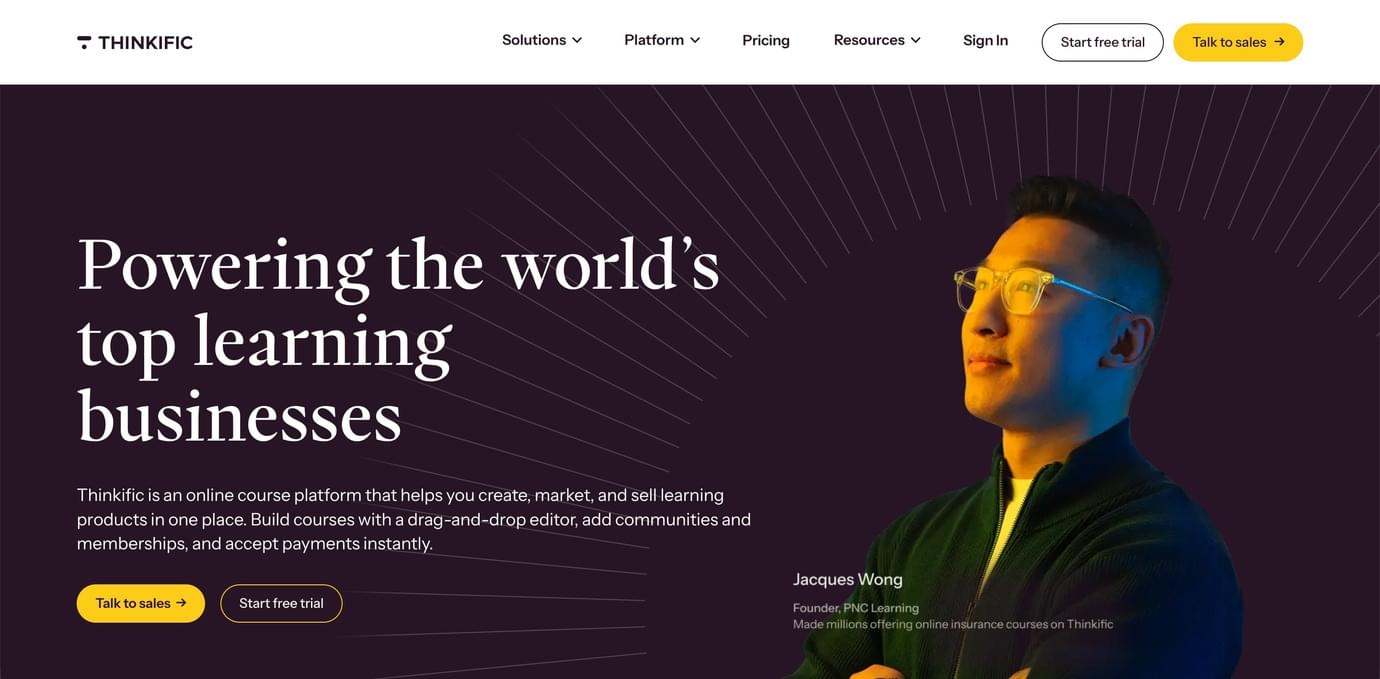 Thinkific is a long-established online course platform focused on helping creators build and sell learning experiences without code.
It gives you tools to upload videos, organize lessons, add quizzes and surveys, and design a learning path that fits your audience. From its dashboard, you can create standalone course sites or embed course access into your own domain, making it easy for creators to establish a digital product presence quickly. Thinkific also includes basic marketing tools like customizable landing pages, email automation, coupons, and order bumps to help drive sales.
The core strength of Thinkific is its focus on delivering structured learning. Creators who value clear course pathways, blended content types, and professional delivery will find its lesson builder and multimedia support reliable and intuitive.
However, Thinkific’s focus on courses sometimes overshadows deeper business tools. Its built-in community capabilities are very limited compared to dedicated social spaces, and full engagement features like member directories, interactive posts, and community discussions require external tools.
While Thinkific supports memberships, the experience feels more like gated content than a cohesive social environment where students connect and engage naturally.
Another constraint comes from marketing and sales stacks. Thinkific doesn’t offer the same breadth of built-in funnels, public community growth engines, or advanced AI assistance that other platforms include.
Live streaming features require separate integrations, and many creators end up stitching together additional software for live sessions, webinars, advanced automations, or analytics. Over time, these add-ons increase cost and operational complexity, especially if your business model expands beyond structured courses.
Price of Thinkific:
From $48/month
Who is it for?
Educators, coaches, and creators who want a focused platform to build polished courses with structured learning paths, certificates, and integrated sales tools.
Best of Thinkific Features:
- Professional course builder with multimedia lessons, quizzes, and surveys
- Memberships and bundled products to increase recurring revenue
Cons:
- Community features are basic and not designed for long-term engagement or organic growth
- Live streaming and advanced event tools require third-party integrations
- Marketing tools, funnels, and automation are limited
- Additional external tools increase cost and complexity as businesses scale
How does Thinkific compare to Heights Platform?
Thinkific helps creators launch polished learning experiences without technical setup. It is strong on structured course delivery and clean student pathways.
Heights Platform expands that foundation into a complete creator business ecosystem. Unlimited courses, products, and communities are included from the start. Public community posts can be indexed by search engines, helping your programs attract organic traffic over time.
Live streaming and group meeting rooms are built directly into Heights under your own branding. Integrated AI tools assist with building offers, optimizing settings, and planning outreach inside the platform itself. Where Thinkific relies on integrations for community and live events, Heights delivers these natively, keeping your workflow streamlined and your costs predictable as you grow.
#6: Teachable
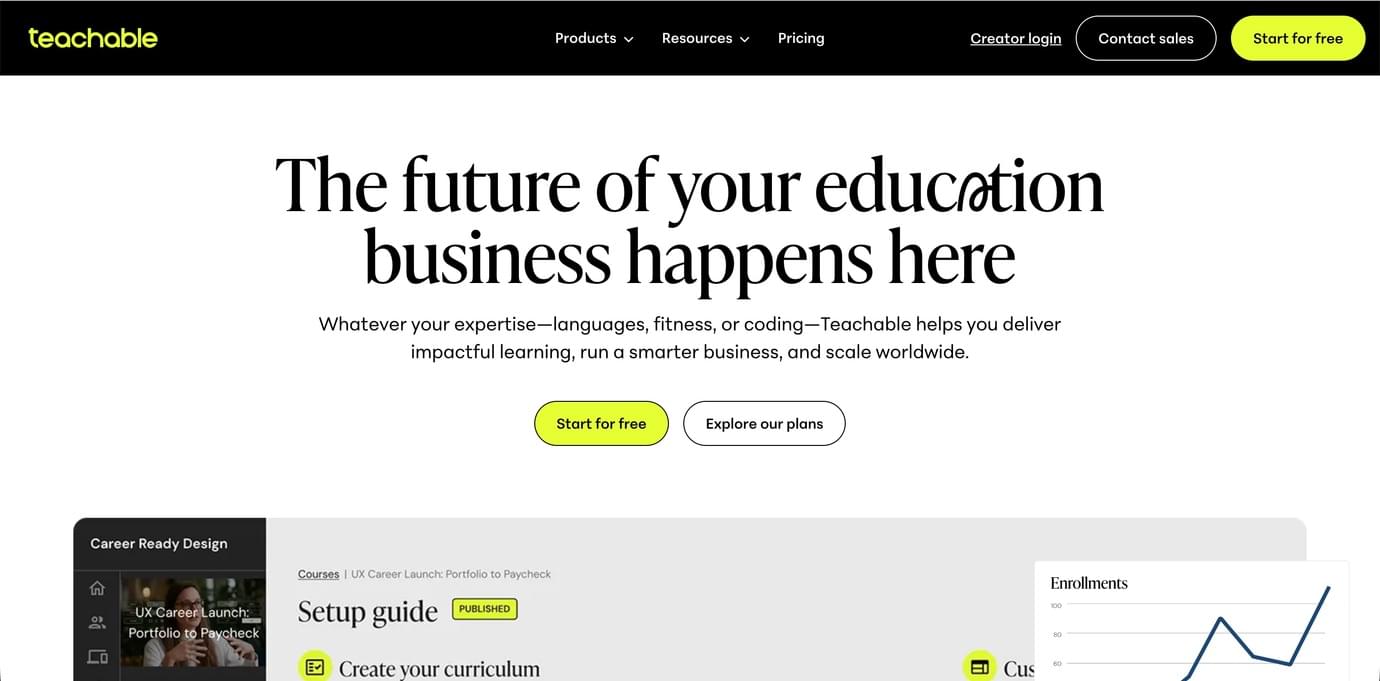
Teachable is a course platform built to help creators sell learning products and deliver them in a polished student experience. You can create and sell courses alongside coaching, digital downloads, and memberships, then connect them to sales pages and checkout.
Teachable offers all the basic tools you'd expect from an online course platform, however, its main trade-offs show up when you look at scaling and how “all-in-one” you want your system to be.
The entry plan includes a transaction fee and caps you at a single published product, which can push creators to upgrade once they want to sell more than one offer. Even on higher tiers, Teachable uses published‑product limits, so creators with a large catalog need to plan around those caps.
Community is included on paid plans, but live streaming is still something many creators handle through integrations rather than running everything natively inside the learning space.
And while Teachable includes AI-assisted creation, the AI capabilities are quite limited and do not function as a business copilot that can actively run workflows and reduce admin across your whole program.
Price of Teachable:
From $39/month
7.5% transaction fee applies on the Starter plan
Who is it for?
Course creators and coaches who want a straightforward platform for selling structured learning products, with payments and checkout handled inside the same system.
Best of Teachable Features:
- Global payments and tax handling for selling internationally
- Upsells and cart recovery tools to increase order value
Cons:
- Transaction fee on the Starter plan despite being a paid subscription
- Published product limits by plan (1 on Starter, 5 on Builder, 25 on Growth, 100 on Advanced)
- Live sessions typically rely on integrations like Zoom rather than being fully native
How does Teachable compare to Heights Platform?
Teachable works well if your business centers around structured courses and you want payments, checkout, and optional community features inside one ecosystem.
Heights Platform is designed for creators who want to scale without watching product caps or transaction percentages. Heights includes 0% transaction fees and unlimited products and students starting at $39/month.
Beyond course delivery, Heights integrates community spaces that can be indexed by search engines, built-in live streaming and group meeting rooms, and AI tools that help you build, optimize, and grow your knowledge business without depending on external software.
#7: LearnWorlds
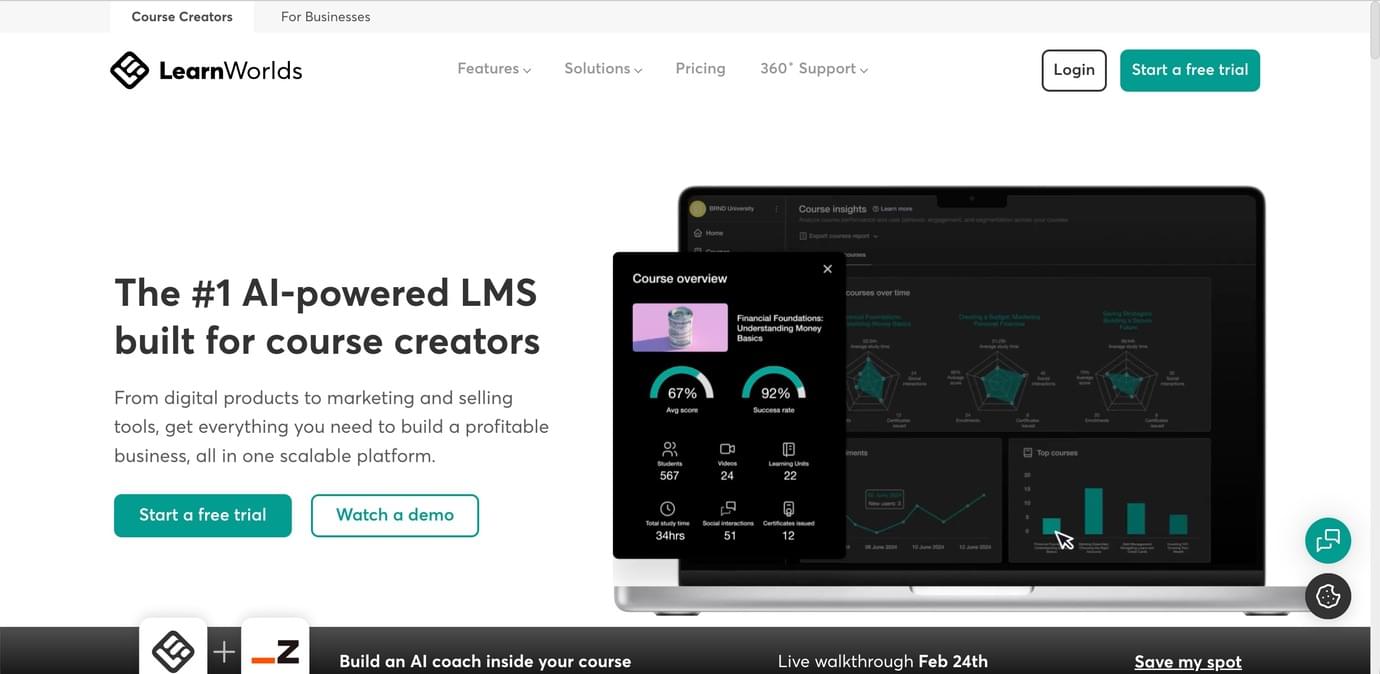
LearnWorlds is a course platform built for creators and training businesses that care about structured learning and detailed learner analytics. It gives you a flexible course builder with multiple activity types, plus strong assessment options and completion tracking.
LearnWorlds stands out for its interactivity: you can turn videos into clickable learning experiences by adding questions, buttons, overlays, and navigation within the video itself, which can boost completion and retention when your content is lesson-heavy. When integrated with learning management software, these interactive videos can also make it easier to deliver, track, and manage engaging learning content.
It also supports SCORM/HTML5 content and includes a website builder with pages and funnels depending on the plan you choose.
If mobile learning is important, LearnWorlds offers a mobile app builder as an add-on for Pro Trainer and above.
LearnWorlds’ trade-offs tend to show up in cost and operational complexity as you scale. The entry plan includes a $5 fee per course enrollment, which can add up quickly once you’re selling consistently, and it also doesn’t allow free courses on that plan.
Many of LearnWorlds’ strongest features (funnels, memberships, affiliate management, more admins, deeper reporting, and broader automation) sit higher in the pricing ladder, so creators are often forced to upgrade.
It’s also a platform that leans more towards traditional learning instead of catering to newer creator needs.
Price of LearnWorlds:
From $29/month
+ $5 fee per course enrollment on the Starter plan
Who is it for?
Creators and training teams who want a course-first platform with interactive video, structured assessments, and SCORM support, and who value formal learning design and detailed reporting.
Best of LearnWorlds Features:
- Interactive video lessons with in-video elements and engagement tools
- SCORM and HTML5 support for packaged training content
Cons:
- $5 fee per course enrollment on the Starter plan, and no free courses on that tier
- Many marketing features are only available on higher plans (funnels, memberships, affiliate tools, advanced reporting, additional admins)
- Branded mobile apps are an add-on and require Pro Trainer or above
How does LearnWorlds compare to Heights Platform?
LearnWorlds is a strong option when your priority is interactive learning design, SCORM-based training, and detailed course analytics, especially if your audience expects a more traditional LMS-style experience.
Heights Platform is built for creators who want a complete business system that stays simple as they grow. Unlimited products and communities are included from the start, along with built-in live streaming and group meeting rooms under your own branding.
Heights also supports public community posts designed for organic visibility, helping your programs attract new traffic over time. Instead of stacking add-ons and upgrades, Heights keeps your workflow streamlined and your growth predictable.
#8: Mighty Networks
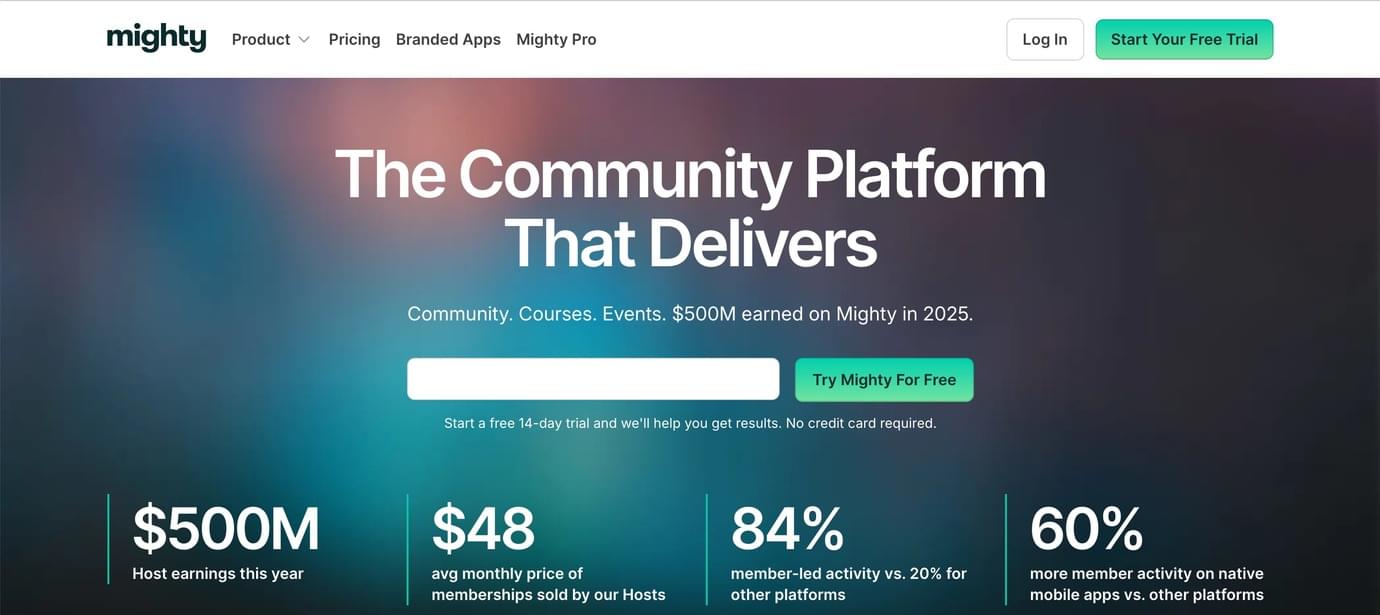
Mighty Networks is a community-first platform designed to help creators build a paid membership with discussion, events, and shared progress.
Mighty Networks is built around Spaces, so you can organize your community into areas for conversations, chat, events, content, and courses, all under one brand and one login. It supports both on-demand and cohort-style courses, and it leans heavily into live sessions with native livestreaming events inside the platform.
If your business model is “membership + ongoing experiences,” Mighty Networks can feel cohesive: you can charge subscriptions or one-time payments, run events, and keep conversations close to where the experience happens.
However, Mighty Networks cannot be defined as a true "all-in-one" tool for creators, with many features missing or needing an external integration. Also, its pricing jumps quickly between plans, and the platform charges transaction fees that vary by plan, so your platform costs can grow with your revenue.
Mighty Networks is also optimized for a community-led business more than a full creator commerce stack. If your growth strategy relies on SEO content, public discovery, a full website/blog workflow, and deeper marketing automation, you may still end up layering additional tools and processes around Mighty to run the business end-to-end.
Price of Mighty Networks:
From $79/month
+ transaction fees starting at 2% depending on plan
Who is it for?
Creators building a community-led membership business where events, discussions, and ongoing engagement are the core value of the experience.
Best of Mighty Networks Features:
- Community-first Spaces combining chat, events, and content formats in one branded experience
- On-demand and cohort-based courses delivered inside the same platform
Cons:
- Transaction fees vary by plan (listed as 2% / 1% / 0.5% / 0.5%)
- Costs increase as revenue grows and as you move from Launch to Scale to Growth plans
- Not designed as a complete creator business stack if you need strong SEO publishing and broader marketing workflows
How does Mighty Networks compare to Heights Platform?
Mighty Networks is a strong option when your product is the community itself and you want a mobile-first membership experience built around engagement, events, and discussion.
Heights Platform is built for creators who want a complete business system without platform transaction fees. Unlimited products and communities are included, keeping your costs predictable as you grow.
Heights supports public community posts that can be indexed by search engines, helping your discussions attract new customers over time instead of serving only existing members. Built-in live streaming and group meeting rooms are delivered directly inside your program under your branding, reducing the need for external live tools as your business expands.
#9: Kartra
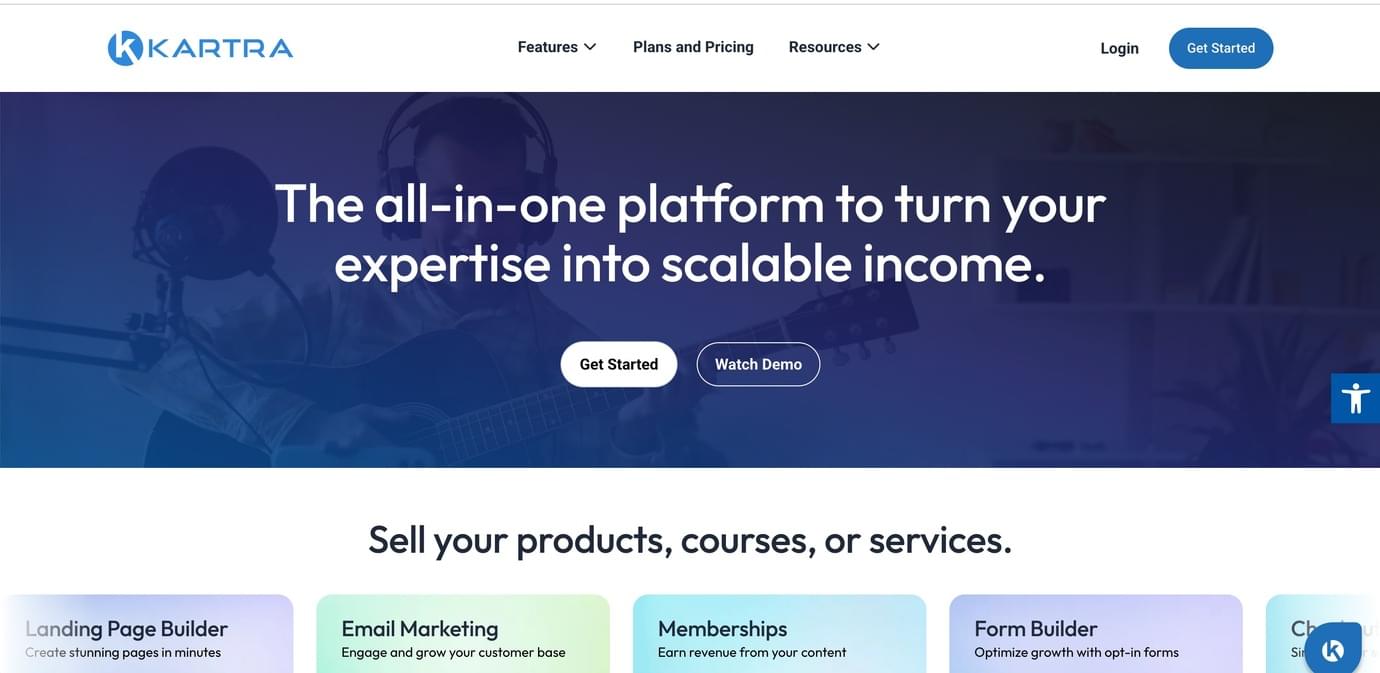 Kartra is a marketing-first platform built to help creators and online businesses run their entire sales machine from one dashboard. It combines landing pages, funnels, email and SMS marketing, lead management, checkout, and affiliate management so you can capture leads, nurture them, and convert them without stitching together separate tools.
It also includes a membership area (often used to deliver courses or gated content), built-in video hosting, a helpdesk portal, and a scheduling calendar, so you can run product delivery, support, and bookings alongside your marketing.
If your business is driven by funnels, campaigns, and automation-heavy sales flows, Kartra can replace a stack of marketing tools in one place, especially for creators selling coaching, services, memberships, or a small set of flagship offers.
Kartra’s trade-offs become apparent when you consider community building and an engaging course experience. Kartra includes memberships/courses, but it’s not a course platform first, in the same way that Heights Platform or Kajabi are; Kartra’s “community” is positioned more as user resources and groups for Kartra customers than a built-in, creator-owned community experience for your students.
If your business depends on members posting, interacting, and building momentum inside a community space and delivering engaging courses, Kartra can feel restrictive.
Price of Kartra:
Starts at $59/month
5% transaction fees apply on the lower plan
Who is it for?
Creators and businesses that prioritize funnels, automation, and structured lead-to-sale marketing systems over community-led engagement.
Best of Kartra Features:
- Funnels, landing pages, email and SMS marketing, lead management, checkouts, and affiliate management in one system
- Behavior-based automation and analytics across the full funnel
Cons:
- Lower plan charges 5% transaction fees and starts with tighter usage limits
- Not designed as a creator-owned community platform for deep student engagement
- Can feel heavy if your main goal is course and community delivery rather than marketing automation
How does Kartra compare to Heights Platform?
Kartra is a strong choice when your business is primarily a marketing operation focused on funnels, automation, email and SMS campaigns, and conversion tracking, with a membership portal used mainly for gated access.
Heights Platform is built for creators who want learning and community to be the center of the business. Courses, communities, live sessions, and engagement tools are native, not secondary features.
While Kartra leans heavily into marketing infrastructure, Heights balances growth and delivery inside one ecosystem. Built-in live streaming, group meeting rooms, public community posts for organic visibility, and unlimited products create a foundation designed for long-term creator businesses.
#10: Systeme.io
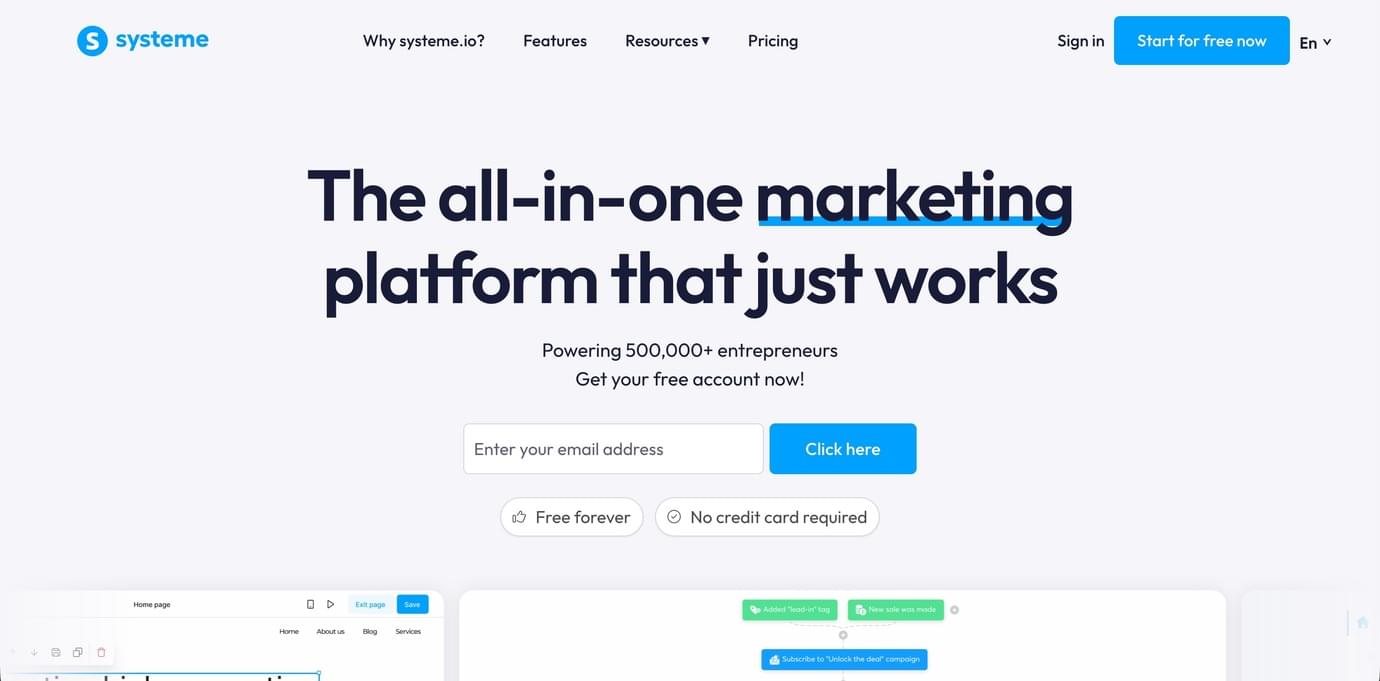 Systeme.io is an affordable, marketing-first platform built to help creators launch funnels and start selling fast.
It combines a funnel builder, email marketing, automations, and checkout tools in one dashboard, so you can capture leads, run nurture sequences, and sell products without stitching together separate software.
The platform is especially known for being accessible: you can start on a free plan, build multiple funnels, and send unlimited emails, which makes it attractive for creators who want to validate an offer before committing to higher monthly costs.
On the product side, Systeme supports online courses and memberships, with a simple course area you can structure into modules and lessons. It also includes communities, letting you create member spaces tied to your offers, so customers can interact in a private environment under your brand.
However, course delivery and community engagement often feel more basic than platforms built specifically for student experience and community-led retention.
Even though Systeme supports courses and communities, it’s not built around learning engagement or a community engine that drives organic discovery over time.
Price of Systeme.io:
Free plan available
Paid plans start at $17/month
Who is it for?
Creators and online businesses that want a low-cost, funnel-and-email setup where marketing automation is the primary focus.
Best of Systeme.io Features:
- Funnels and templates designed for fast launching
- Unlimited emails on all plans, including the free plan
- Automation rules and workflows that scale by plan
Cons:
- Course and community experience is basic
- Key limits scale by plan (contacts, funnels, automation rules, courses, communities)
- Not built around organic community discovery as a growth channel
How does Systeme.io compare to Heights Platform?
Systeme.io is often chosen when creators want an affordable, marketing-first system where funnels and email automation are the main engine, and courses or community features play a supporting role.
Heights Platform is built for creators who want the product experience—courses, community, and live delivery—to be the center of the business, while still having strong marketing tools inside the same ecosystem.
With unlimited products, built-in live streaming and meeting rooms, and public community posts designed for organic visibility, Heights provides a more balanced foundation for creators focused on long-term growth rather than only funnel optimization.
#11: GoHighLevel
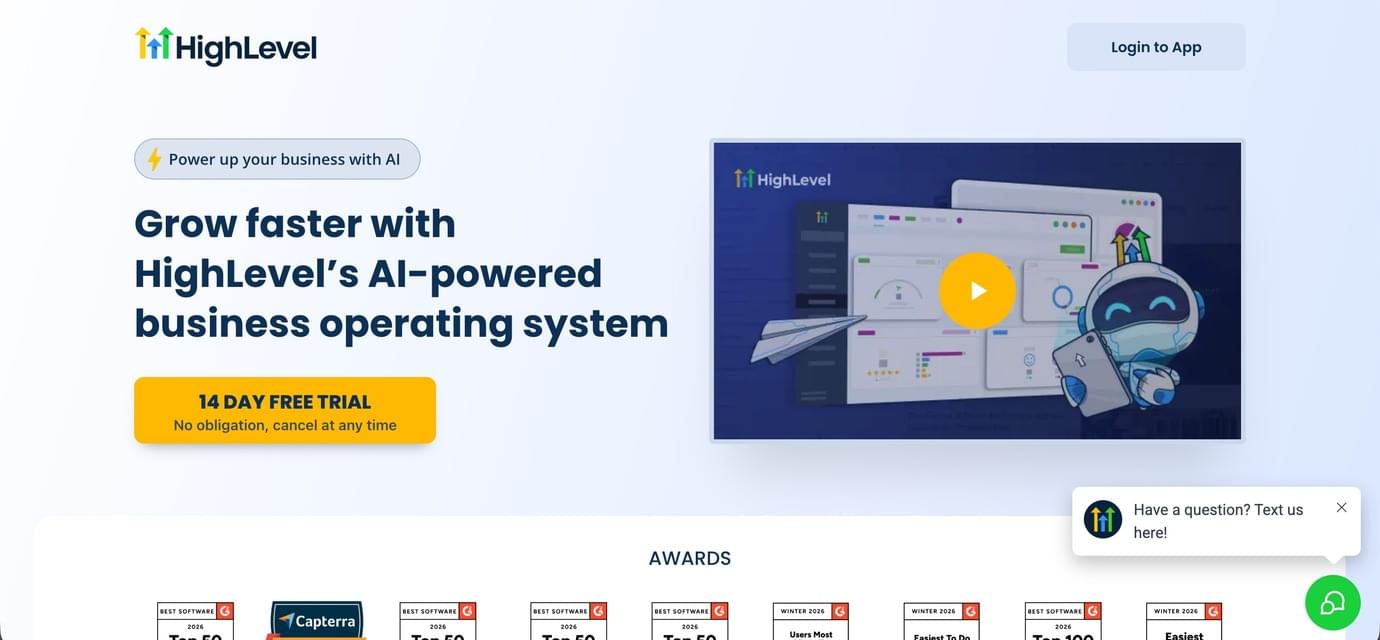 GoHighLevel (often branded as “HighLevel”) is an all-in-one CRM and marketing automation platform built primarily for agencies and service businesses that want to generate leads, nurture them, and manage pipelines in one system.
It combines a CRM with website and funnel building, forms, calendars, email and SMS marketing, and automation workflows. GoHighLevel also includes Membership Sites, which let you deliver gated content like courses, onboarding hubs, and client training under your own domain.
Where HighLevel shines is the “system” side: pipeline + follow-up + booking + messaging + reporting working together. If your business runs on leads, appointments, and multi-step follow-up, it can replace a stack of separate tools and keep your operations tightly connected.
But, GoHighLevel is not a course and community platform at its core. While it has membership/course capability, learning engagement tools and community aren’t the center of the product in the way dedicated creator platforms like Heights Platform and Kajabi are.
Pricing is also structured around “sub-accounts,” which makes perfect sense for agencies, but can be less intuitive if you’re a solo creator who doesn’t need multiple client accounts.
And because HighLevel is broad and automation-heavy, it can take more setup and ongoing optimization to get the best results, especially if your goal is to publish a course, build a community, and start delivering quickly without building a complex CRM machine first.
Price of GoHighLevel:
From $97/month
Who is it for?
Agencies and service-based businesses that want a CRM, funnels, automations, and appointment booking system to manage lead flow and client operations in one place.
Best of GoHighLevel Features:
- CRM, pipelines, and automation workflows connected to funnels, forms, calendars, email, and SMS
- Agency-friendly structure with sub-accounts for managing multiple client businesses
Cons:
- Not course-first, so the learning and community experience is not as specialized as dedicated creator platforms
- Pricing and structure are optimized for agencies, which can feel excessive for solo creators
- Steep learning curve for creators focused mainly on course and community delivery
How does GoHighLevel compare to Heights Platform?
GoHighLevel is strongest when your business is built around lead management and appointment pipelines. CRM workflows, automations, and follow-up systems are the core engine.
Heights Platform is built for creators who want the course and community experience to be the center of the business. Engagement tools, unlimited products, built-in live streaming, and group meeting rooms are designed to help you scale content and interaction without rebuilding your stack later.
While GoHighLevel prioritizes client operations and agency workflows, Heights focuses on helping knowledge creators grow, engage, and expand inside one streamlined ecosystem.
#12: Whop
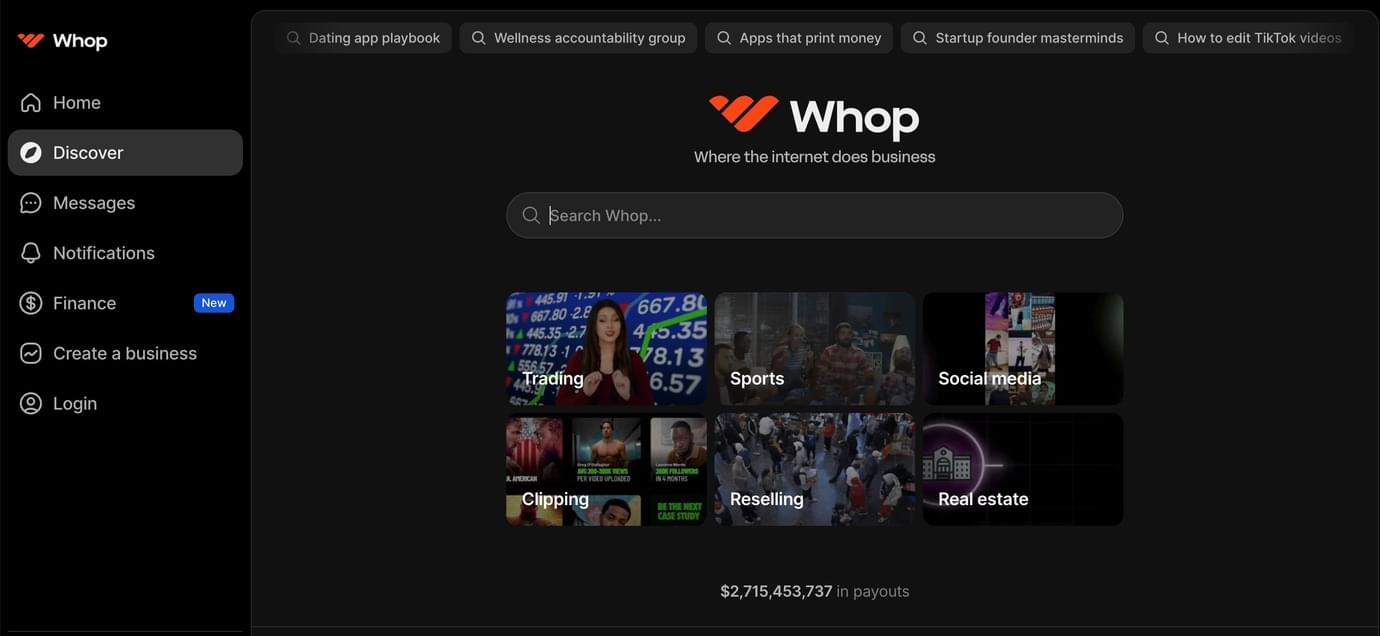 Whop is a commerce platform that helps creators sell digital products, memberships, communities, and services from one place, with a strong “storefront + apps” model.
You create a “whop” (your customer home base), then turn on the features you need using modular apps: things like chat, courses, forums, livestreams, file delivery, events, and more.
A big part of Whop’s appeal is the fact that you can start selling without paying a monthly subscription, and Whop positions its pricing as “free to start,” with payment processing fees shown on its pricing page (for example, 2.7% + $0.30 per transaction).
Whop also works as a marketplace: you can get listed on the Whop Marketplace, and the platform positions itself as a place where buyers discover paid communities and offers.
The biggest downside is branding. If you want a business that feels fully “yours” and is optimized for long-term learning and brand growth, Whop is not for you.
Whop includes course and community functionality through apps, but the overall system is built as a modular storefront and marketplace first, not offering advanced course and community features and therefore limiting students' engagement and customers' retention.
Whop’s pricing structure can be complex, with multiple fees depending on the plan and services used. In addition, Whop operates as the merchant of record, meaning that it may manage refunds and compliance processes directly, and reserves can be applied in certain cases. As with any platform that handles payments on your behalf, it’s important to understand how refunds, chargebacks, and potential reserves are handled so you can plan your cash flow accordingly.
If your goal is to build a high-engagement learning experience under your brand, Whop can feel more like a simple storefront rather than a complete creator platform.
Price of Whop:
Free to start
Platform and payment processing fees apply depending on setup
Who is it for?
Creators selling memberships, paid groups, and bundled digital offers who want a modular storefront-style setup.
Best of Whop Features:
- App-based storefront customizable with chat, courses, forums, livestreams, files, and more
- Marketplace listing that can support platform-based discovery
- No monthly subscription required to get started
Cons:
- Fees can include payment processing plus additional platform or service fees
- Cash flow may be affected by compliance reviews or reserves in some cases
- Course and community depth is app-based and may feel lighter than platforms designed around structured learning engagement
How does Whop compare to Heights Platform?
Whop can be a fit when you want a fast, modular storefront with a central hub and you value marketplace-style distribution.
Heights Platform is built for creators who want a complete business under their own brand. Courses, community, website, marketing tools, and live engagement features are integrated into one ecosystem designed for long-term growth.
With Heights, you keep 100% of your earnings. You pay a flat monthly or annual fee for the platform, without transaction-based revenue sharing, making scaling more predictable over time.
#13: Skool
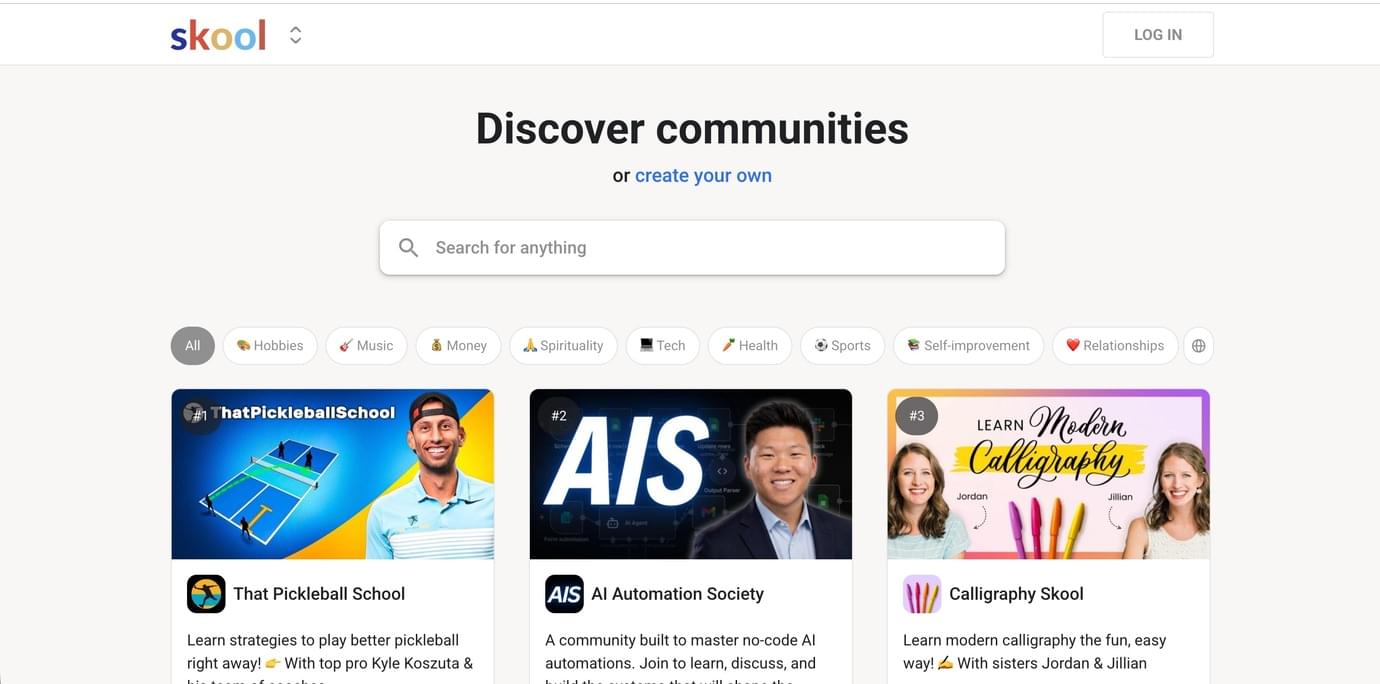 Skool is a community-first platform built around one simple idea: keep members active through a clean feed, built-in courses, and gamification.
Inside one group, you can publish posts, run discussions, and organize learning in a course area with videos, pages, resources, searchable transcripts, and progress tracking. Skool also includes a calendar for scheduling events, with timezone support and reminder emails.
Members earn points and levels for participation, and you can use levels and rewards to keep momentum high or even unlock content over time.
However, Skool is quite limited in terms of what the platform allows you to create. Skool is intentionally focused on “one group = one business hub,” which can be limiting if you want multiple communities or a more diverse product catalog under one roof (any new group means that you have to pay for another subscription).
Skool also uses its own payment flow and applies transaction fees depending on plan and payment size, which can impact margins as you scale, especially for higher-ticket offers.
Price of Skool:
Hobby $9/month and Pro $99/month
Transaction fees apply (typically 10% on lower tiers and around 2.9% on higher tiers, depending on plan and payment size)
Who is it for?
Creators running a single community membership who want a simple, engagement-focused setup.
Best of Skool Features:
- Gamification with points, levels, and rewards to drive participation
- Community discoverability through the Skool marketplace
Cons:
- Transaction fees apply and vary by plan and payment size
- Primarily designed around a single group; multiple groups require additional subscriptions
- Not built as a complete website, course, and marketing system for scaling a broader creator business
How does Skool compare to Heights Platform?
If you only need to build one community membership, Skool can be an option focused on simplicity and gamified engagement.
Heights Platform is built for creators who want a complete business they can grow without limits. Multiple product types, deeper workflows, built-in live streaming and meeting rooms, and community structures that support public and organic growth are included from the start.
Heights also includes AI as an active assistant inside the platform, helping you build, organize, and manage faster. Instead of only hosting a group, Heights supports the full lifecycle of a scalable knowledge business.
#14: ThriveCart
 ThriveCart is a checkout and conversion platform built to help creators sell digital products with high-performing payment pages, upsells, and affiliate tracking.
It’s best known for optimizing the “last step” of the funnel: turning a visitor into a buyer with fast checkouts, one-click upsells/downsells, order bumps, coupons, and behavior-based automation like abandoned cart and dunning.
ThriveCart also includes a simple course delivery product called ThriveCart Learn, so you can route customers from purchase to course access without connecting a separate LMS.
Where ThriveCart really shines is revenue optimization and tracking. It emphasizes attribution and performance insights (like comparing funnels and tracking campaigns with UTM reporting) so you can see what’s actually driving sales and improve conversion rates over time.
ThriveCart’s biggest limitation is that it’s not a true all-in-one creator platform, because it’s designed around checkout, not around running your whole business in one place.
In practice, many creators still need additional tools for a full website, blogging/SEO publishing, deeper community experiences, and broader marketing operations.
Price of ThriveCart:
$495 one-time lifetime license (Standard)
Optional upgrades include Pro+ (~$295/year) and Learn+ (~$195 one-time)
Who is it for?
Creators and digital businesses who already have a marketing stack and want a powerful checkout system to improve conversion rates, add upsells and order bumps, and run affiliate-driven launches with stronger tracking.
Best of ThriveCart Features:
- High-converting checkout flows with order bumps and upsells/downsells
- Affiliate management and advanced sales tracking (including Pro+ features)
- One-time lifetime pricing for the standard plan
Cons:
- Not a complete course, community, and website platform; primarily a checkout and optimization tool
- Separate tools are usually required for courses, community, and broader marketing workflows
- Upfront lifetime pricing plus optional upgrades can require a larger initial commitment
How does ThriveCart compare to Heights Platform?
ThriveCart is a strong option when your priority is optimizing checkout flows, increasing average order value with upsells, and managing affiliates, while running the rest of your business across other tools.
Heights Platform is built for creators who want their courses, community, website, and engagement experiences under one roof. Instead of connecting multiple systems, you can manage your content, live sessions, and growth workflows inside one ecosystem.
Heights also includes robust, conversion-focused checkout capabilities, allowing you to sell effectively without separating your sales process from your learning and community experience.
#15: SamCart
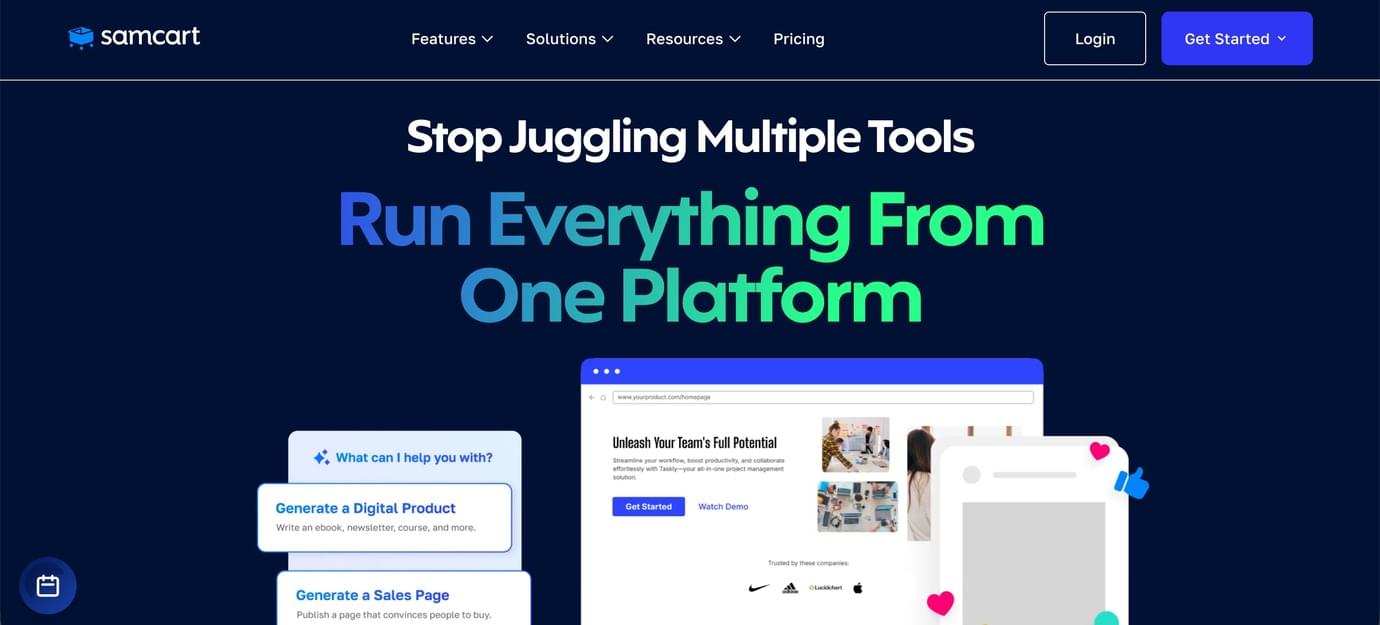 Similar to ThriveCart, SamCart is a checkout platform built to help creators sell digital products with stronger payment pages and higher average order value.
You can create clean product checkouts and offer boosters like order bumps, upsells, and cart-abandonment recovery without complex setup.
SamCart also supports subscriptions and saved cards, and includes tools like “Subscription Saver” to reduce failed payments and protect recurring revenue.
In addition to checkout, SamCart offers a Courses App for simple course delivery. You can host video lessons and resources, drip content, and auto-enroll students right after purchase.
SamCart’s trade-offs show up when you want a true all-in-one course and community platform. Its strength is selling, not building a learning experience: so community building, engagement mechanics, and ongoing member activity aren’t the core product experience.
Pricing can also be less predictable than a flat “creator platform” subscription. SamCart currently offers a single pricing plan, with costs that scale with your business, which can become more expensive as revenue increases.
Price of SamCart:
Starts at $79/month
After a 7-day free trial. Pricing adjusts as your business grows.
Who is it for?
Creators and online businesses that prioritize checkout conversion and want tools focused on increasing average order value and recovering abandoned carts.
Best of SamCart Features:
- High-converting checkout with upsells and order bumps
- Cart abandonment recovery and subscription-saver tools
Cons:
- Not a course and community-first platform
- Course delivery is simpler than dedicated learning platforms
- Pricing increases as revenue grows
How does SamCart compare to Heights Platform?
SamCart is a focused checkout engine designed to improve conversions, increase order value, and optimize subscription revenue. It works well when your main priority is refining the payment experience.
Heights Platform is built for creators who want the course and community experience to be the center of the business. Engagement tools, structured content delivery, built-in live streaming, and community spaces live inside one branded home.
Instead of separating checkout from learning and engagement, Heights connects selling and delivery inside one ecosystem designed for long-term growth.
#16: LearnDash
 LearnDash is a WordPress plugin that adds online course-building functionalities to your WordPress site. Instead of being a hosted “all-in-one” SaaS, it works as a plugin you install on your own website, which gives you a lot of control over design, structure, and how your learning experience fits into your existing brand.
LearnDash supports structured courses made up of lessons and topics, plus quizzes and question banks to check understanding and guide progress. It also includes certificates and Groups, which are commonly used for team training, corporate cohorts, or selling course access in bulk.
Because it runs on WordPress, LearnDash can connect to a wide ecosystem: you can add ecommerce, email marketing, CRM, analytics, and community features using other WordPress plugins and integrations.
That said, WordPress can become complex and frustrating quite fast for creators.
As LearnDash is a WordPress plugin, not a single unified platform, it means you’ll typically need to choose and manage hosting, themes, security, backups, payments, email tools, and often extra plugins for the exact (or even worse) experience you'd get by using a dedicated course platform.
Community is a good example: LearnDash’s own approach commonly relies on WordPress forum/community plugins (like bbPress integration), which can work well, but it adds setup steps and ongoing maintenance compared to a native community built into a course platform.
If you are already comfortable with WordPress, then LearnDash can help you add courses to your site, but it’s not the fastest and easiest path for someone who wants courses, community, live delivery, and marketing in one connected system (without tech headaches!).
Price of LearnDash:
From $199/year
1 site license (WordPress plugin)
Who is it for?
Creators, educators, and training businesses already using WordPress (or wanting full website control) who are comfortable managing a WordPress-based setup to build a tailored course experience.
Best of LearnDash Features:
- Structured courses with lessons, topics, quizzes, and advanced question tools
- Flexible ecosystem through WordPress plugins and integrations
Cons:
- Not a single all-in-one platform; hosting, plugins, updates, and your broader stack must be managed separately
- Community typically requires third-party WordPress plugins rather than being native
- Live sessions and advanced marketing workflows are usually handled through external tools and integrations
How does LearnDash compare to Heights Platform?
LearnDash is a strong option if you want a WordPress-native LMS and prefer building a customized setup with themes, plugins, and full site control.
Heights Platform is built for creators who want a complete system without assembling multiple tools. Courses, community, website, marketing tools, and live streaming are integrated inside one platform.
Instead of managing hosting, plugins, and updates separately, Heights provides a streamlined environment designed for running and scaling a knowledge business from one place.
#17: Stan Store
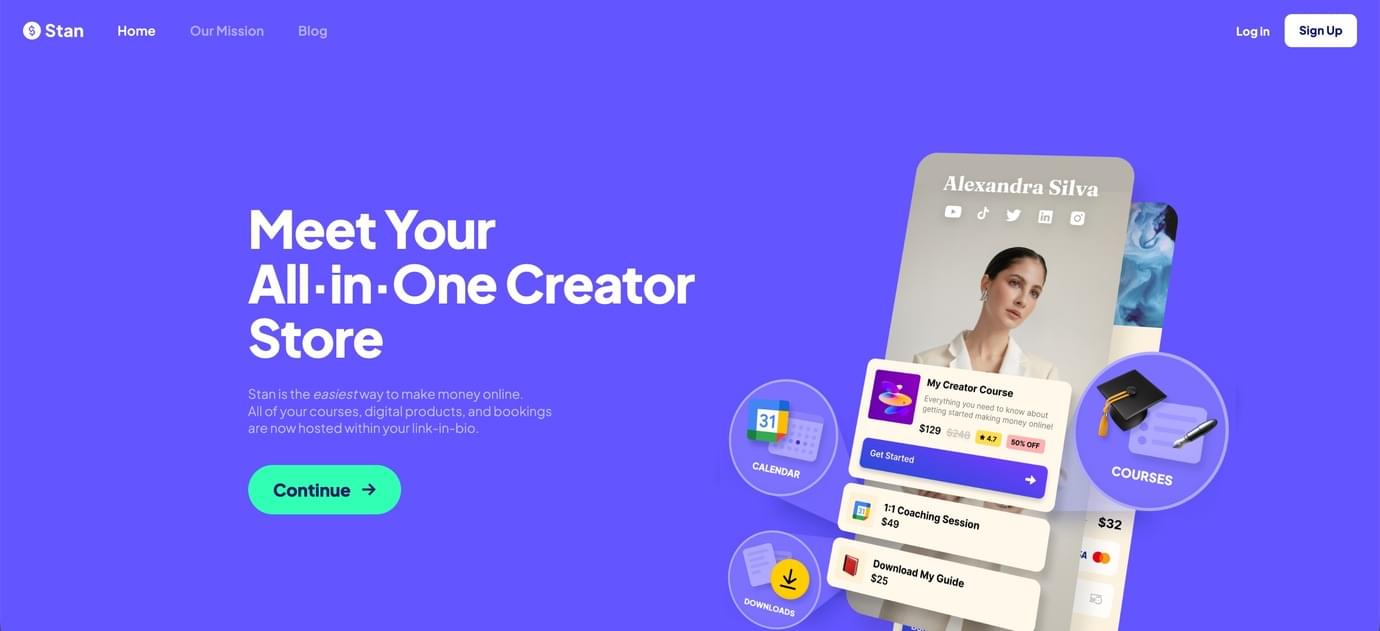 Stan Store is a link-in-bio creator storefront designed to help you monetize an audience quickly without building a full website. Your products live inside one mobile-friendly page, so followers can buy courses, digital downloads, memberships, and even book calls from the same link you place on Instagram or TikTok.
You can set up a clean storefront, publish offers, and start selling with minimal setup, which makes it popular for creators who already get most of their traffic from social platforms.
Even though Stan Store positions itself as an “all-in-one creator store," it doesn't offer the same amount of features as dedicated course and community platforms do.
Price of Stan Store:
Starts at $29/month
Who is it for?
Creators with an existing social audience who want a fast link-in-bio storefront to monetize followers without building a full website.
Best of Stan Store Features:
- Link-in-bio storefront optimized for mobile conversions
- Simple setup designed for quick monetization
Cons:
- More limited compared to full creator platforms
- Pricing structure can feel unclear as features expand
How does Stan Store compare to Heights Platform?
Stan Store is a simple tool for quickly monetizing a social audience through a streamlined link-in-bio storefront.
Heights Platform is built for creators who want a complete business under their own brand. Courses, community, website, marketing tools, and live streaming are integrated into one ecosystem designed for long-term growth and engagement.
Heights also includes AI tools that help you build, organize, and run your business directly inside the platform. Creating a professional link-in-bio page is easy using the AI website builder, while still giving you the depth to expand beyond a simple storefront.
What is the difference between a course platform and a course marketplace?
If your goal is to build a real creator business (not just upload content and hope it sells), you need to understand the difference between a course creation platform and a course marketplace.
A course creation platform (like Heights, Kajabi, Thinkific, Teachable, LearnWorlds) is software that lets you build your own branded site, host your courses, control pricing, and own the relationship with your students.
You decide how your business works: one-time purchases, memberships, bundles, payment plans, cohorts, private communities, live sessions: the whole structure is yours to design.
You also keep direct access to your students’ information and engagement data, which matters because that’s how you build retention, referrals, and repeat sales over time. On a course platform like Heights Platform, you can decide how much to charge for your courses, and usually the platforms do not take a high percentage of your earnings (for example, Heights Platform doesn't charge any transaction fees!).
A course marketplace (like Udemy or Skillshare) is more like an “Amazon for courses.” You upload your course into a catalog with thousands of other creators, and the marketplace helps with discovery by sending you traffic.
That can sound appealing early on, especially if you don’t have an audience yet, but the trade-off is control: marketplaces typically set the rules, influence pricing, and take a cut of your revenue in exchange for access to their customer base.
Where creators usually get stuck is choosing what feels easiest today instead of what scales later. Marketplaces can be a quick way to validate a topic and get initial students because the audience already exists.
But if you want to grow into a premium brand, increase your pricing, and build predictable revenue, a course platform like Heights gives you a stronger foundation because you own the brand, the customer relationship, and the business model.
A simple way to think about it: marketplaces help you get discovered, platforms help you build a real business. If you want your community, content, SEO, and student experience to compound over time, choose a platform.
Start Free TodayFrequently Asked Questions
What is the best all-in-one platform to sell online courses and build a community?
The best all-in-one platform is the one that lets you create courses, run a community, host your website, and market your offers without adding extra software. Heights Platform is a good choice for creators because it combines courses, community, website building, email marketing tools, and built-in live streaming in one system, while keeping pricing predictable with no transaction fees and allowing you to scale with unlimited products.
Which platform is best for building a community around a course?
If community is a core part of your program, look for a platform with strong community features and engagement tools, not just comments under lessons. Heights Platform is designed for course + community together, with built-in community spaces and engagement features that keep students active while they learn, so you can create a thriving hub where people keep coming back, even after they have completed your course.
What platform is best for selling courses without transaction fees?
Many platforms charge transaction fees on lower plans, which reduces your margin as you grow. Heights Platform is positioned around predictable pricing and zero transaction fees, so the platform cost doesn’t rise just because your revenue grows.
Which platform is best for beginners creating their first online course?
Beginners usually need a platform that is easy to launch with, but also flexible enough to grow into later. Heights Platform works well here because you can start simple, then expand into more products, community features, and live delivery without switching platforms. It also includes AI tools that help speed up setup and execution.
What is the best platform for online courses and live workshops, coaching calls, and webinars inside your program?
If you plan to offer live sessions and courses as part of your business model, you need a platform that runs them natively and under your own branding. Heights Platform includes live streaming and meeting rooms inside the platform, so you can run calls, workshops, and streams without relying on separate webinar or video tools - all under your own name, brand and logo.
What is the best alternative to Kajabi for course creators?
Kajabi is strong for funnels and email automation, but it’s expensive and has product limits on lower tiers. Heights Platform is a popular Kajabi alternative for creators who want an all-in-one system with more flexibility, no transaction fees, and unlimited products and communities as they scale.
What is the best alternative to Thinkific or Teachable?
Thinkific and Teachable are solid course platforms, but many creators end up paying for extra tools for community, live sessions, and customer engagement. Heights Platform is a strong alternative when you want all of those features built in, especially if you want to grow your community and integrate live calls directly into your branded program.
Do I need a website builder to sell online courses?
You don’t need one to start, but you will need a strong web presence if you want consistent traffic and predictable sales. A website helps you publish content, rank on Google, and build trust. Heights Platform includes website building and blogging alongside courses and community, so your website and products stay connected in one system.
What platform helps you grow an online business without relying on social media?
To grow outside of social media and with strong SEO, you need content that can be indexed by search engines, like blog posts, landing pages, and public content that keeps working over time. Heights Platform supports SEO-friendly publishing and also allows public community posts that can be indexable by Google, helping creators build organic traffic through content and discussion.
Start Free TodayDisclaimer: The pricing, features, and product details mentioned in this article are accurate as of March 2026, based on publicly available information at the time of publication. We aim to keep this comparison up to date and will revise this article if we become aware of significant changes.


