
Why Community Matters More Than Online Courses in 2026
7 minute readThinking of starting your own online business in 2026, but you are not sure of which digital product to launch? Then you are in the right place.
The online business and digital product landscape has changed dramatically during the past 5 years or so, due to technological advancements like AI.
If you think about how creators made money in 2020, one clear winner comes to mind: online courses.
Starting in 2020, courses were booming. People were stuck at home, looking for new skills, and online learning felt like a breakthrough. You could learn anything from anywhere, often for the first time. That alone made courses extremely valuable.
But the environment around courses has shifted. Today, offering access to information is no longer an advantage alone.
With AI tools, people can get highly specific answers in seconds. Instead of watching a 2-hour module to find one insight, they can ask a question and get a tailored response immediately. The barrier to learning is gone.
So much so that many creators worry that online courses are "dead". We don't believe that online courses are a thing of the past, well, at least not all online courses. Today, we are going to share how creators can stay relevant and ahead in 2026, and which online courses will survive the AI era.
Online courses are still one of the most common ways creators start an online business in 2026. That hasn’t changed. If you have knowledge, packaging it into a structured course still feels like the obvious first step.
And not all courses are in trouble. But courses that only deliver information, without context or interaction, are losing relevance. An example of the courses that aren't so valuable anymore is the marketplace-type courses you'd see for $9.99 that share generic information, which you can now simply get from ChatGPT. The higher value courses, where someone shares their unique experience and knowledge to help others achieve a specific result, are still performing as well as they ever had, because AI can't replace that.
What’s replacing that value is not more content: it’s a connection. That’s why communities matter more than courses in 2026.
Keep reading below to learn how to start and grow an online community in 2026, and which elements make a course and community business thrive.
Online Communities: How Creators Stay Relevant in 2026
So we've established that finding information is no longer the main problem people are trying to solve in 2026.
If someone wants to learn how to start a newsletter, build a course, or get clients, they can find answers instantly. They can ask AI tools like ChatGPT specific questions, refine them, and get step-by-step guidance tailored to their situation; or watch an in-depth video tutorial on YouTube, and so on.
But what is interesting is that, even with all that information available, most people still don’t follow through.
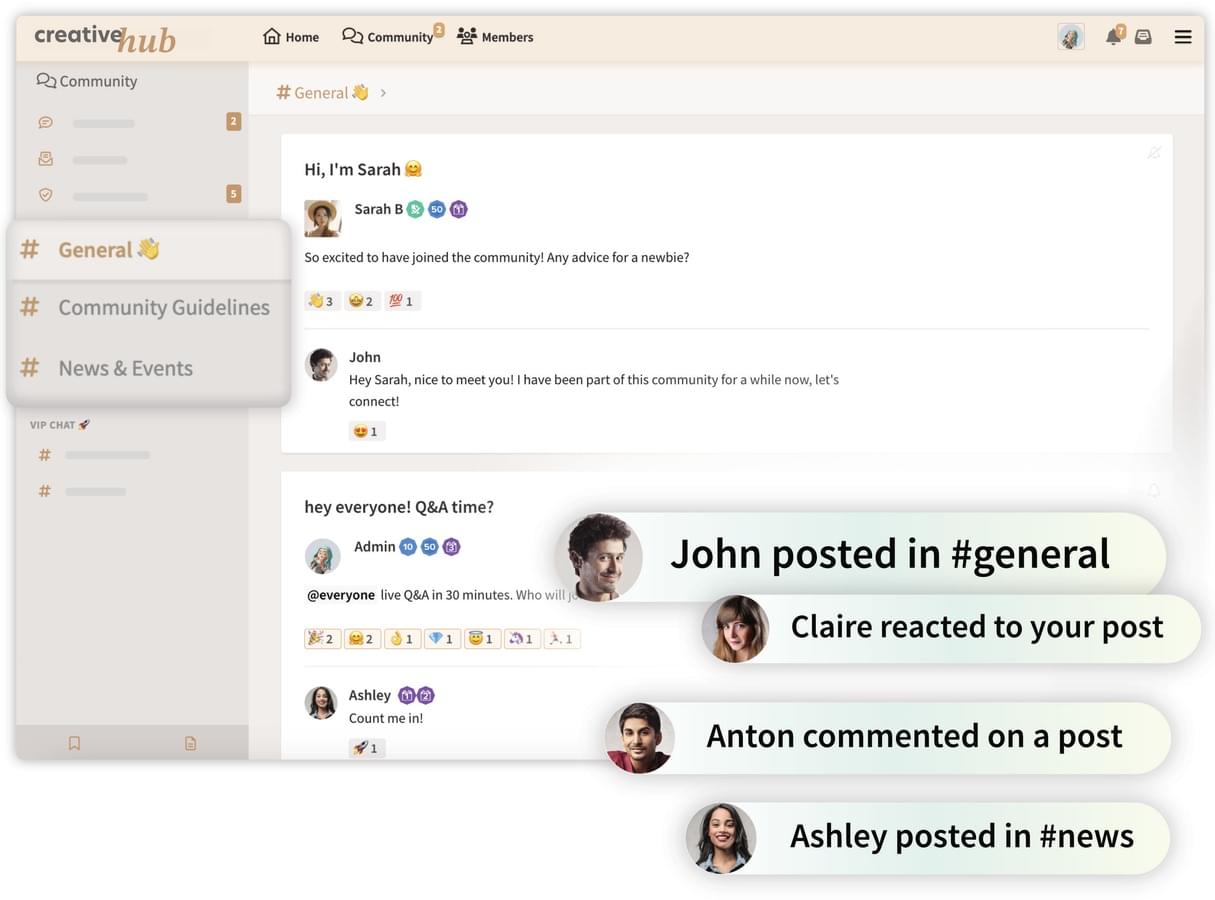
Even with all the information and guidance in the world, people still need human support. Has it ever happened to you that you were searching online, or asking ChatGPT to solve a problem for you, but...
- You were unsure if you were doing things the right way
- You didn't get feedback on what you were building
- You lost consistency after a few days or weeks
- You felt like they were working alone
And you wished you had a community of real people going through the exact same ordeal as you, to which you could ask questions and get support from?
This is where a community becomes more valuable than a course alone. A course gives you a clear path to follow, and a community helps you stay on that path.
For example, imagine someone building their first online course. They can learn everything they need from videos or AI tools. But when they start writing their course outline, they will have questions like: “Is this topic too broad?”; “Would someone actually pay for this?”; “How should I structure the first module?”
And sure, they can ask these same questions to ChatGPT, or Claude, or Grok... but human feedback is still more valuable compared to ever-agreeing bots.
Inside a community, they can post their outline, get feedback from other creators, and improve it quickly. They can also see what others are building, which helps them move faster and avoid common mistakes.
Communities also create consistency. When people see others sharing progress, launching offers, or getting results, it pushes them to keep going.
Even simple things like weekly check-ins or progress posts can make a big difference. This is why, in 2026, the role of a creator is changing. You are not only creating content. You are creating and moderating an environment where people can ask questions, share progress, get feedback and stay consistent over time.
Not to mention that a big value of communities is connecting with like-minded people. Hearing from others who are going through the same situation can be very valuable, and it is something that AI cannot replace.
How to Start and Grow a Thriving Community and Course Business
One of the main challenges in starting an online community, is getting people to participate and come back regularly.
Many creators open a community, invite people in, and then nothing happens. A few posts, no replies, and within a few days it feels inactive.
This usually comes down to two things: lack of focus and lack of consistency.
Start by choosing a clear outcome for your community.
Avoid something broad like “a space for entrepreneurs” or “a marketing community.” When the topic is too general, people don’t know what to post or how to engage.
Instead, define exactly who the community is for and what they are trying to achieve.
For example, you could build a community for:
- creators launching their first course
- freelancers getting their first 3–5 clients
- coaches building a paid membership
Now when someone joins, they immediately understand what kind of discussions happen inside.
Once the focus is clear, your next job is to create activity. In the beginning, most people will not post on their own. They are waiting to see how the space works.
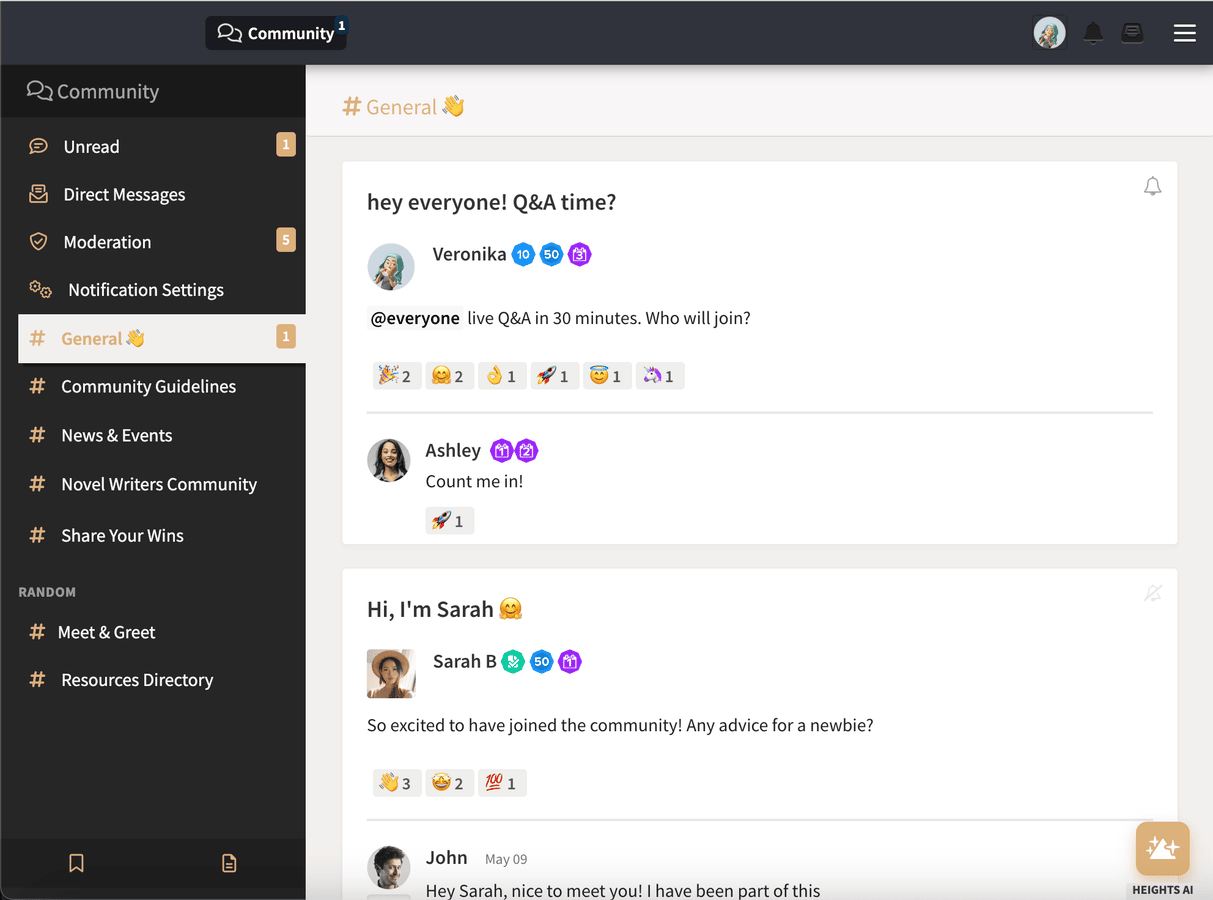
That is why you need to lead that behavior by showing up consistently and posting things people can respond to easily.
For example, you could ask members what they are currently working on, invite them to share something they are building, highlight a member’s progress and ask others for feedback, or post your own work and explain your thinking, and so on...
These are simple actions, but they give people a reason to engage.
Over time, as members start interacting with each other, the community becomes more active without you needing to drive every conversation.
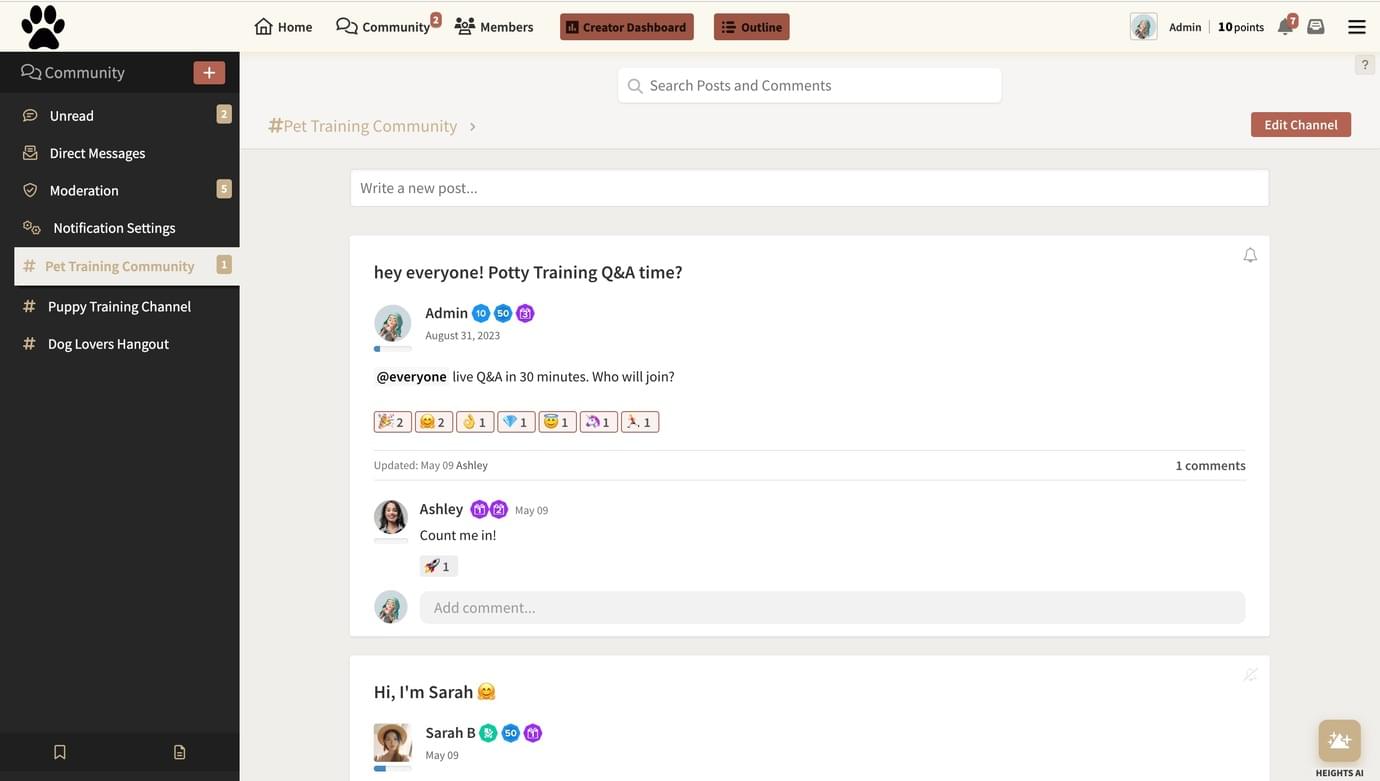
Moderation is just as important as activity. If people join and see low-quality posts, spam, or irrelevant discussions, they stop paying attention. You need to guide what gets posted and how conversations happen.
This can be done manually, especially in the early stages. As your community grows, AI tools can help you filter content, flag issues, and surface the most useful discussions so members don’t miss them.
The platform you use also has a direct impact on growth. For example, if your community is private and hidden, only people you invite will ever see it.
But if parts of your community are public and can be indexed by Google, your discussions can show up in search results. Someone might search for a specific problem, find a real conversation inside your community, and decide to join after reading it.
This turns your community into a way to attract new members, not just manage existing ones. If you are also building a course, it is important to link it to your community, or build in the same space if your platform allows it.
This way, you can:
- allow members to discuss each lesson directly under the content
- encourage them to share their work as they go through the course
- answer questions inside the community so others can learn from them too
This creates a loop where content leads to discussion, and discussion makes the content more useful.
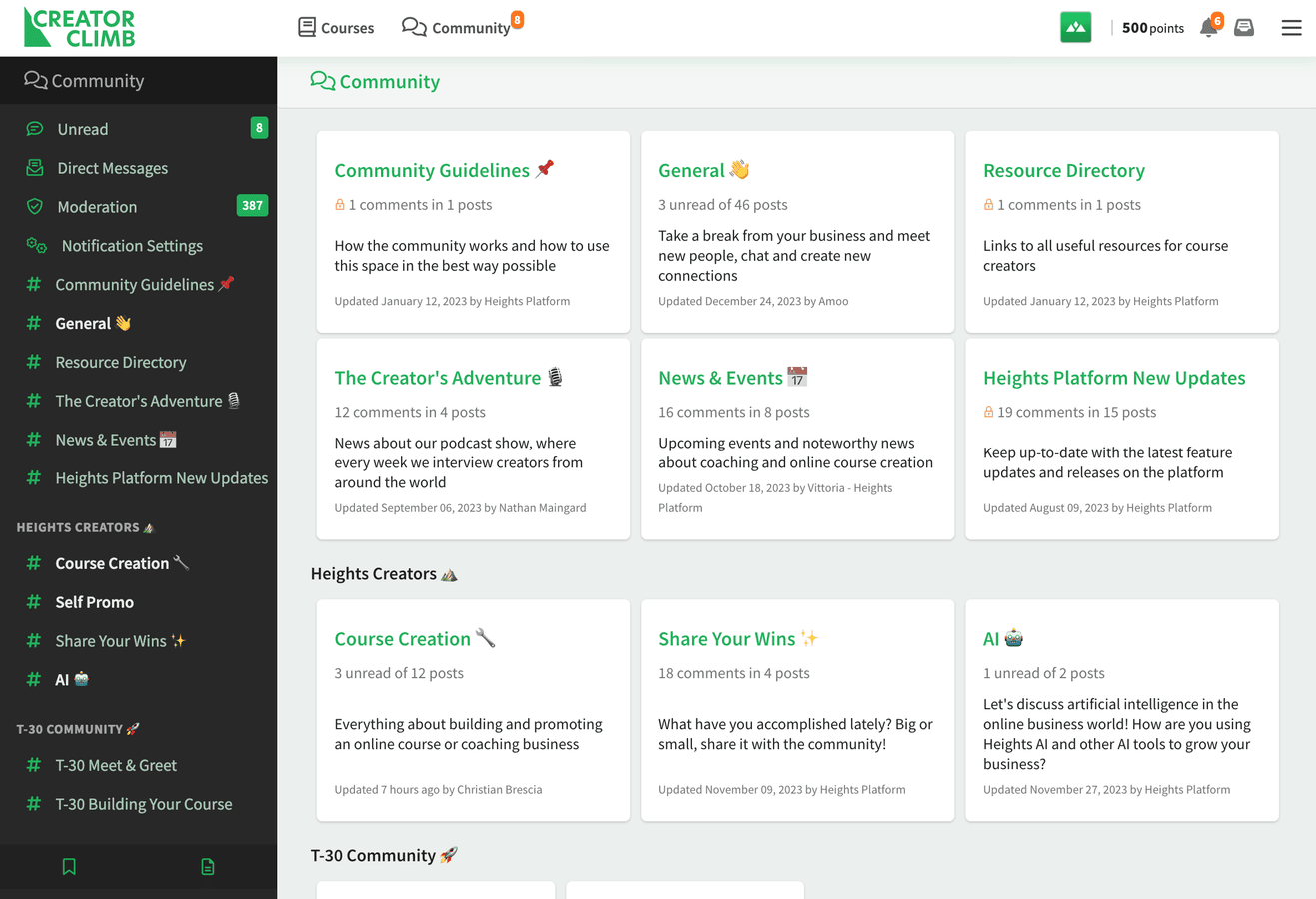
With platforms like Heights Platform, you can do all of what we mentioned (and more) in one place!
You can host your courses and digital products, run your community, and use AI tools to support moderation and engagement. You can also make parts of your community public so new people can discover it through a simple Google search.
This setup removes the need to manage multiple tools and makes it easier to build something people actually use.
Related articles:
- Best Online Course and Community Platforms in 2026 [All-in-One Platforms for Creators]
- How to Grow Organic Traffic With Public Community Posts
- How to Launch an Online Community With AI in 6 Steps
At the end of the day, a strong community and course business is not built on content alone. It is built on consistent interaction, clear structure, and a space where people can make progress with others.
Wrapping It Up
Online courses are still a strong way to package knowledge and make money online. If you have a skill or experience, turning it into a structured course is still one of the simplest ways to start an online business.
But what people expect from a course has changed.
Access to information is no longer the main reason someone will pay. They can already find answers, tutorials, and step-by-step guidance for almost anything.
What they cannot easily get on their own is personalized, real feedback, support, and a push to be more consistent. This is where community becomes essential.
If someone goes through your course but has no place to ask questions, no one to review their work, and no reason to stay consistent, there is a high chance they will stop halfway.
On the other hand, if they are part of a group where others are working toward the same goal, sharing progress, and asking questions, they are much more likely to follow through.
This is why the most successful creators in 2026 are not choosing between courses and communities: they are building both together!
Once you understand this, the next question that probably comes naturally is: but how can I build both without paying for multiple platforms?
And the answer is simple: choose a platform that offers all of these features (selling courses, building community, designing your website, and using marketing tools to grow your business) all in one place!
Heights Platform does exactly that and more. Try it yourself by creating your free account! (free for 30 days, and you don't need a credit card to get started).
Start Your Online BusinessFrequently Asked Questions
Are online courses still worth it in 2026?
Online courses are still a strong way to start an online business in 2026. At Heights Platform, we personally believe that not all courses are in trouble. But courses that only deliver information, without interaction, might be losing relevance. For example, marketplace-type courses that are sold $9.99 that share generic information, which you can now simply get from ChatGPT. The higher value courses, where someone shares their unique experience and knowledge to help others achieve a specific result, and where members can interact and connect, are still performing as well as they ever had, because AI simply can't replace that.
Why are online communities becoming more important than courses?
Online communities are becoming more important because they solve problems that information alone cannot. People need feedback, support, and accountability to follow through. A community allows members to ask questions, share progress, and stay consistent over time.
Can AI replace online courses?
AI can replace parts of an online course, especially when it comes to delivering information. However, it cannot replace human interaction, feedback, and shared experiences. This is why combining courses with a community is becoming the preferred approach by creators in 2026.
How do you build a successful online community in 2026?
A successful community starts with a clear focus and a specific outcome for members. From there, consistency is key. Creators need to actively post, guide discussions, and encourage participation. Over time, members begin contributing, and the community becomes more active.


