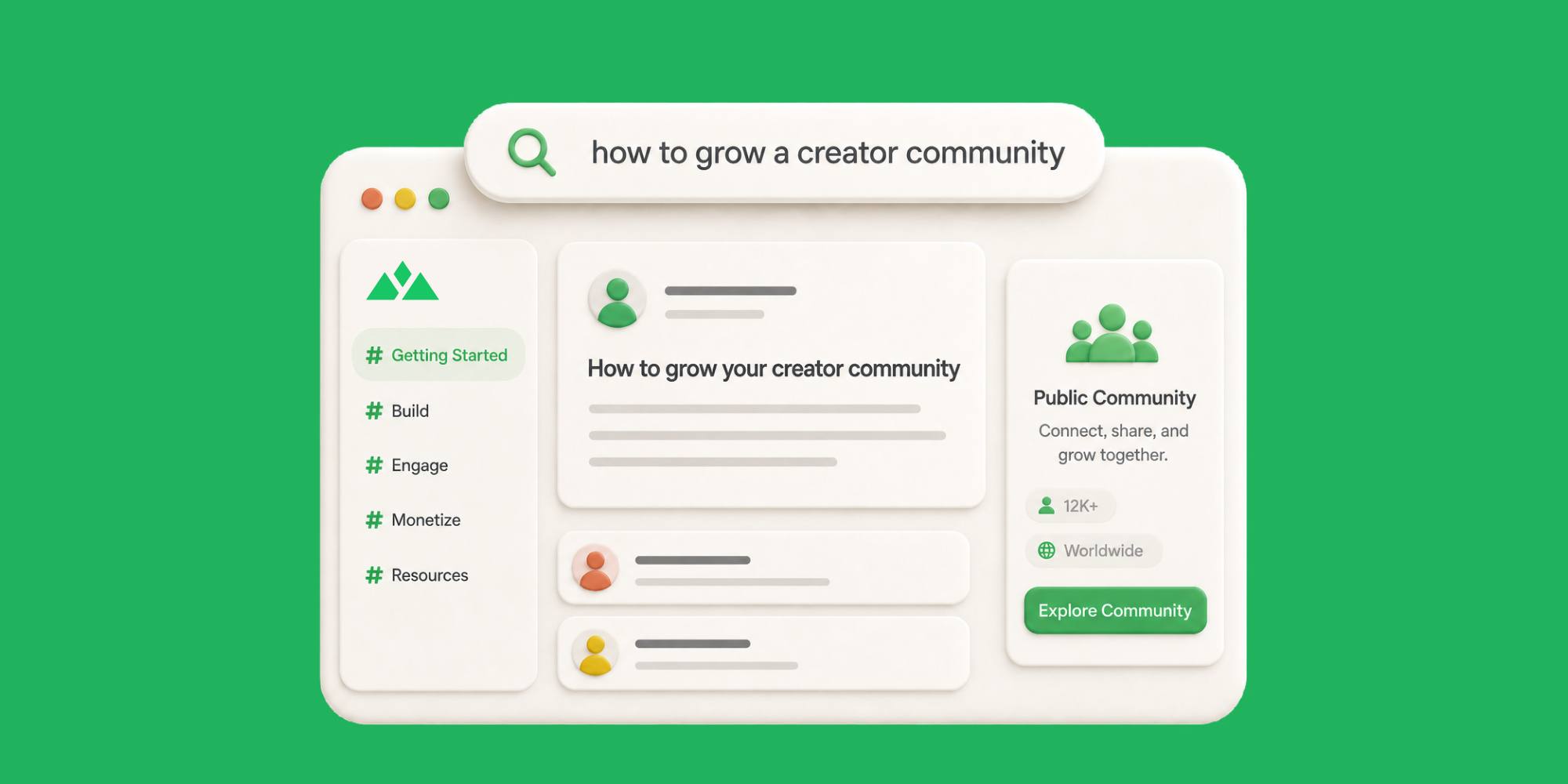
Why Public Communities Are the New SEO Strategy for Creators
9 minute readSEO has changed a lot in the past few years.
For a long time, the typical SEO strategy for creators was simple: write blog posts, target keywords, optimize your titles, add internal links, and wait for traffic to come in.
That still works, and blogging is still a valuable way to increase organic traffic and grow your business without depending on social media algorithms.
But the way people search for information online has changed.
Today, people do not only search for polished articles. They search for real answers, specific examples, personal experiences, product recommendations, honest feedback, and conversations from people who have already solved the problem they are trying to solve.
They want to know what worked for someone else, and see how others are thinking through the same challenge. They want the kind of advice that usually appears inside communities, not inside perfectly written blog posts.
Think of Reddit or Quora, and the level of trust that users have towards these sites.
The problem for businesses with platforms like Reddit is that self-promotion is highly frowned upon, and advertisement on these networks is not seen positively by their users.
But there is another SEO strategy that can help creators rank on search engines with minimal effort, and even get mentioned by LLMs like ChatGPT and Claude: building a public community.
Public communities are becoming one of the most powerful SEO opportunities for creators.
A public community turns real conversations from your audience into discoverable content. Instead of hiding every question, answer, win, discussion, and resource behind a login page, you can make parts of your community visible online so new people can find you through search.
With an online community platform like Heights Platform, creators can make their community public and allow search engines to index public community posts. This means your community discussions can appear in search results, helping new people discover your brand, your expertise, and your paid products.
Let’s look at why this matters, how public communities work, and how creators can use them as part of a modern SEO strategy.
The Problem With Traditional SEO for Creators
Traditional SEO usually starts with a keyword. You research what people are searching for, write an article around that keyword, optimize the page, and publish it.
Google says its ranking systems are designed to prioritize helpful, reliable, people-first content rather than content created mainly to manipulate rankings.
This can work well, especially when your content is specific, helpful, and based on real experience. And up until now, it was the main way to make your website and blog rank on search engines.
But in 2026, creators and bloggers are facing new challenges. With the use of AI, users are not using the internet in the same way as before.
Instead of searching for keywords on Google and hoping to find a helpful answer by reading multiple articles, they go directly to ChatGPT (or other LLMs) and ask specific, detailed questions that directly apply to their situation.
Suddenly, long and generic blog posts are not the most popular or helpful resource on the internet.
Content based on keyword instead of real audience questions, posts that sound similar to everything else already ranking, articles that cover broad topics instead of the smaller, more specific problems their audience actually has - are not as valuable anymore.
For example, a creator teaching photography might write a blog post called “How to Take Better Photos.” That topic is fine, but it is extremely broad.
Inside their community, however, students might be asking much more specific questions: “How do I take sharper indoor photos without expensive lighting?” “Why do my portraits look flat even when I use a good camera?” “What settings should I use for family photos on a cloudy day?” “How do I pose people who feel awkward in front of the camera?”
These questions are more useful because they reflect what real people are thinking about when they are trying to improve. And if real people inside a community are asking these questions, chances are that thousands of other people are also asking these questions to LLMs.
And imagine if, when someone asks a question to ChatGPT, the bot suggests your article or your business as the answer to their problem!
That is the opportunity. If you have an online community, it already contains the exact questions your audience is searching for. And if you don't have it yet, now is the time to build one.
A public community allows those questions and answers to become part of your organic growth strategy.
Why Communities Are Built for Modern Search
As we mentioned, in 2026, search is becoming more conversational: people are searching for the answer to their problems in full questions, and are looking for detailed examples that match their unique situation.
This framework is perfect for the way communities already work.
Inside a community, members do not usually speak in generic keywords. They explain what they are working on, they ask for feedback and describe their context. They share what they tried and what happened.
This creates the kind of content that is very hard to fake.
For example, a blog post can teach someone how to price an online course. But a community thread can show five creators sharing their course ideas, their audience size, their pricing concerns, and the advice they received.
That kind of discussion is more valuable than ever because it is specific and real.
And it is especially important in the AI era. When people can ask AI tools for instant answers, creators need to offer something deeper than generic information. They need to create spaces where people can see real examples, real feedback, and real progress. A public community helps you do that.
What Is a Public Community?
A public community is a community space where posts can be visible to people who are not logged in, just like Reddit posts or blog posts.
In Heights Platform, you can make your community visible to the public by enabling the option to allow search engines to index public community posts.
Once this is turned on, people on the internet can find your community posts, and those posts can appear in search engine results.
You can also add a description and cover image for your public community, share public post pages, and add your public community page to your website navigation.
This means your community can become part of your website, and support SEO. It can also show visitors that your brand is active, and help potential customers see the value of your community before they join.
The important part is that you do not have to make everything public. You can still keep private spaces for paying members, students, or specific groups.
In Heights, channels can also be organized and controlled, including private access through bundles when you want to sell or restrict access to specific community areas.
So public communities are not about giving everything away. They are about choosing which conversations can help new people discover your work, and get your business discovered easily on Google or through LLMs!
Why Public Communities Can Become an SEO Engine
While a blog is usually a one-sided explanation (you decide the topic, write the article, and publish it), a public community is audience-focused.
In a community, your members ask questions, start conversations, share ideas, and create discussions around the exact problems they care about.
This creates a powerful SEO advantage because your content library can grow from real demand. Every helpful public post can become a new entry point into your business.
Now imagine that someone searches on Google for a specific problem, or asks ChatGPT how to fix it, and they find a public community thread from your Heights community.
They read the answer, see more related discussions and gain value from the community post.
And they realize your community is active and valuable for them. On the public community pages, there is an option for them to join your community for free, so they create an account. And now, you have a new lead.
Besides your community, they can also discover your course, membership, coaching program, or digital products. From a lead, they can easily become your paying customers!
All without much effort from your part. Instead of taking the time to write hundreds of blog posts, you simply let your community members create the content for you by asking questions in the public community space.
It is a win-win for everyone. You get free marketing and new leads into your program, and your community members get access to a valuable space where they can connect with others and get answers to their problems.
And for those members who prefer a private space, you can still provide that by making some channels private.
More on this topic: Why You Should Build an Online Community of Engaged Customers and How to Do it
Public Communities Help You Rank for Long-Tail Questions
One of the biggest advantages of public communities is long-tail SEO. Long-tail keywords are specific searches that usually have lower search volume but stronger intent.
For example: “How do I structure my first online course?” “Best way to keep members engaged in a small community” “How do I sell a coaching program without a big audience?” “Should I offer a course, membership, or challenge?”
These are not always the kinds of topics creators turn into full blog posts. Some are too specific, too niche, or better answered through a discussion.
But these are exactly the kinds of questions that appear naturally inside a community. When your community is public, these conversations can become discoverable.
Instead of trying to write a full article for every possible question, your community can capture the smaller, more specific conversations happening around your niche.
It is important to note that a public community does not replace your blog, which is still very valuable for Google ranking and SEO in general. Instead, it strengthens it.
Your blog can cover the main strategic topics, while your public community can capture the real-life questions, examples, and discussions that surround those topics. Together, they create a much stronger content ecosystem.
Public Communities Build Trust Before Someone Joins
One of the hardest things about selling a course, membership, or coaching program is helping people understand what happens after they buy.
This is why it is important for creators to have a landing page that can explain the benefits of joining, with testimonials and information about the course.
But a public community can show the actual experience in real time. Visitors can see the types of questions people ask, they can see how helpful the discussions are, the tone of the community, and whether or not people are active.
This can be especially powerful for creators selling memberships or community-driven programs. When someone is considering joining, they might wonder:
“Will people actually participate?”
“Is the community beginner-friendly?”
“Will I get helpful feedback?”
“Are there people like me inside?”
A public community can answer these questions without needing to over-explain them on a sales page, by giving potential customers a preview of the value.
It also helps your community feel alive from the outside. Instead of a hidden space that only members can see, your community becomes part of your brand presence.
Public Communities Create Content Without Starting From Scratch
One reason creators fall behind on SEO is that publishing content consistently takes time and effort.
Writing blog posts, creating videos, recording podcasts, and building lead magnets all require planning and production that many individual business owners do not have.
Community content comes from the natural activity already happening inside your business: a student asks a question, you answer it, another member adds their experience, and so on.
That single discussion can become a useful public page, without you needing to do anything. And over time, your community creates a growing library of searchable conversations.
How Heights Platform Makes Public Communities Work
Heights Platform gives creators a built-in community space where members and students can interact, ask questions, discuss topics, and share with each other.
Creators can organize conversations into channels, and those channels can be defined by topic so members can easily find the right discussions.
This matters because a public community needs structure. If every discussion is in one general feed, it becomes harder for members to participate and harder for visitors to understand what your community is about.
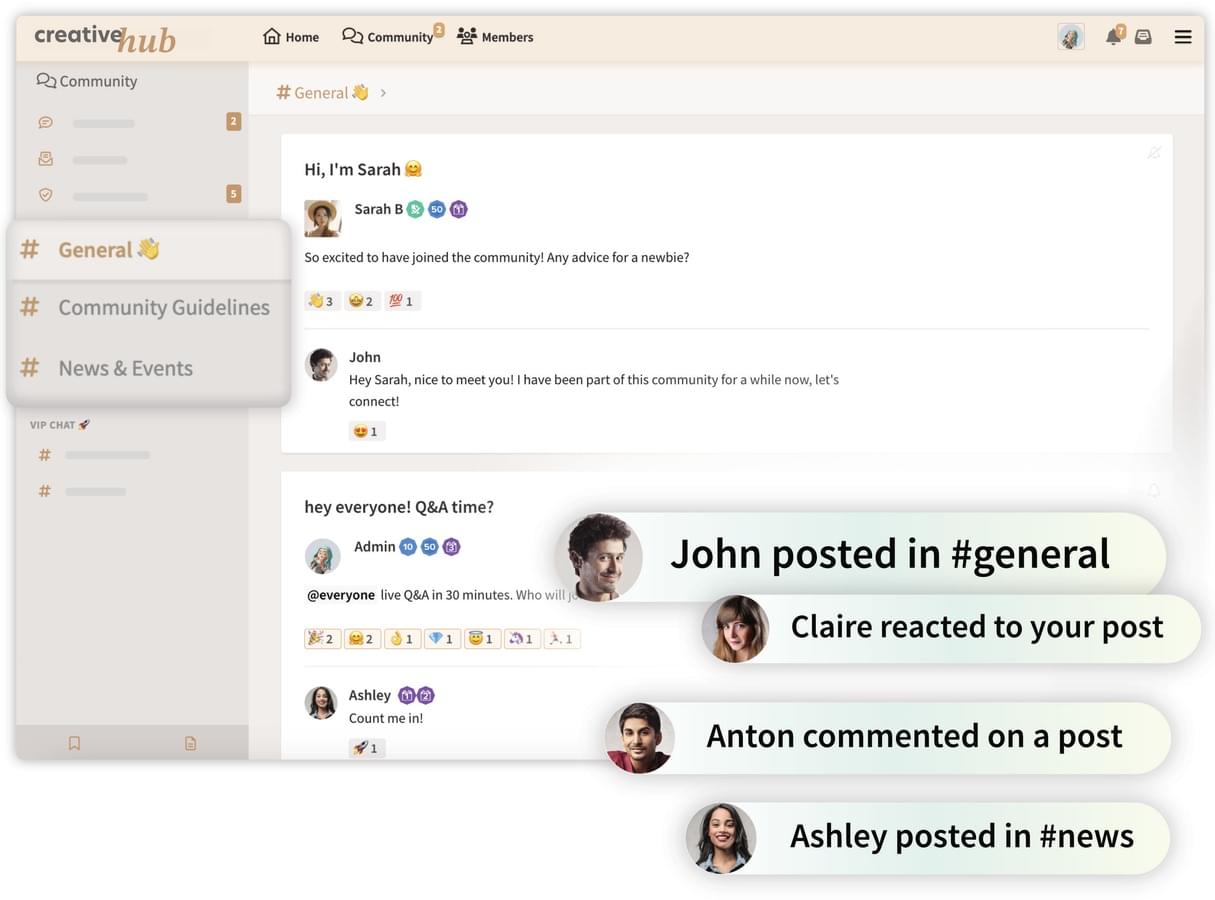
With channels, you can organize your public community around clear topics.
Inside a Heights community, some channels can be open for conversation (public). Others can be locked if you want students to read but not post, which can be useful for announcements or rules. And others can be private, paid or only accessible to people who purchased an offer from you (online course, membership etc...).
Heights also includes moderation options, including AI moderation tools, so creators and moderators can approve or block posts and manage the quality of the community.
That is important because public community SEO only works when the content is useful. A public community should feel like an extension of your brand. You do not want your public community to become filled with low-quality posts, spam, or irrelevant discussions.
Start Your Online Community Today
SEO is no longer only about publishing more blog posts. For creators, SEO is becoming more about discoverability, trust, and real conversations.
People want answers that feel specific to their situation, they want examples and feedback, and they want proof that others are working through the same challenges.
Public communities help creators turn those conversations into a growth channel.
With Heights Platform, you can build a community for your students and members, organize it into channels, moderate discussions, and make part of the community public so posts can be indexed by search engines.
This means your community can help your existing members and attract new people at the same time.
For creators building courses, memberships, coaching programs, or digital products, this is one of the most valuable shifts in organic growth.
Your audience is already asking questions, and if you have a community, the answers to those questions are there. So why not use those conversations to help more people discover your work?
You can try Heights Platform for yourself and create a thriving community, free for 30 days!
Create Your Community Today

